Enrollment for online intensive Czech language course: August stream
07.07.2026selector.space
Enrollment for online intensive Czech language course at EdVista is open: the second stream will start in August 2026. The program takes you from zero to level B2 in 5-9 months. It suits those who plan to enter a Czech university, move or work in the Czech Republic. Enrollment is already open, and the group has a limited number of places.
The first stream showed that the format works: students go through a structured program with fixed deadlines and clear goals at each stage. The second stream repeats this logic. You know in advance how long the training lasts and what level you reach. Below we explain what the program includes, who the August intake suits and how to register before the start.
The EdVista team leads the classes under the founder, a doctor of pedagogical sciences and a lecturer at Masaryk University in Brno. The course structure itself reflects years of teaching Czech to Ukrainian-speaking students.
What enrollment for online intensive Czech language course at EdVista gives you
The online intensive Czech language course is an accelerated program that takes students from zero level to B2 in 5-9 months. However, the duration depends on the starting level and the pace of the group. Classes run online, so you can join from anywhere in Ukraine or abroad.
The intensive differs from regular online Czech language courses in the frequency and density of classes. You study several times a week, and each module builds on the previous one. This provides uniform progress without long pauses, which often dilute what has been learned.
Many people start with individual lessons or apps, and then switch to online Czech courses when they realize they need a system. Intensive fills this need: it sets the pace, sequence of topics, and control over the result. You don’t decide on your own what to learn next, because the program leads you along a set route.
In addition, the format is convenient for those who combine studies with work or school. Classes keep a fixed schedule, materials stay available online, and you receive feedback from the teacher at each lesson. The page of the main intensive program describes the structure and terms in detail.
Who the enrollment for online intensive Czech language course suits
The August intake targets several groups of students. The largest of them are applicants who plan to enter a Czech university and who need a B2 level before submitting documents. For them, the intensive course solves the main task: to bring the language to the required level within the expected time frame.
The second segment is those who are preparing to move to the Czech Republic for work or to their family. Here, academic training is not important, but working Czech for daily communication, documents, and everyday life. The program covers both areas, as it brings the student to B2, which is the level of an independent user.
The third group is students who have already tried to learn the language on their own, but are stuck at the initial levels. Czech language courses for Ukrainians online in the intensive format give them the structure and pace that are lacking in independent learning. Instead of scattered materials, you get a consistent program with progress control. Online intensive Czech language courses return such students to systematic learning and bring them to the desired level in a predictable time frame.
Moreover, the program takes into account that the audience is predominantly Ukrainian-speaking. Explanations build on the proximity of the languages, and the course tackles typical difficulties in switching from Ukrainian to Czech separately. This speeds up learning compared to groups where students have different language backgrounds.
The intake is also suitable for those starting from scratch. Teachers form the group by starting level. Beginners do not lag behind, and those with a base do not repeat what they know.
What is included in the program from zero to B2
The program takes you through all levels of the Common European Framework of Reference for Languages, from A1 to B2. Levels A and B on this scale correspond to the basic and independent user, and the intensive course leads to the latter. You can read the description of the levels on the official website of the Council of Europe.
Overall, each level covers four language skills: reading, listening, speaking and writing. The lessons combine grammar, vocabulary and conversational practice, so you don’t just learn the rules, but immediately apply them in your speech. This is especially important for those preparing for job interviews or living in a Czech-speaking environment.
Language environment and practice with native speakers
The intensive teachers are Czech-speaking, so you are immersed in the language environment from the first lessons. Conversation clubs with native speakers complement the program, and there you practice live communication. Separately, EdVista holds online meetings with specialists from the Czech Republic: programmers, journalists, teachers. They show how language works in a real profession.
In addition, the program includes regular progress monitoring. After each module, you can see what you have already learned and what you need to work on. This approach eliminates the feeling that you are learning blindly and shows real progress towards your goal.
Stages of the route from A1 to B2
The Czech route from zero to B2 follows successive stages with intermediate goals. At the start, the focus is on pronunciation, basic vocabulary and simple constructions. Then the course adds more complex grammar topics, work with texts and extended conversational practice. By the end, you will be confident in using the language in typical educational and everyday situations.
A separate block covers practical situations: communication at the university, document processing, everyday dialogues. Those entering Czech universities should check the application procedure on the official admission portal in advance. This helps coordinate language preparation with the admission campaign.
For those who already have level B1 and want to reach B2 faster, a separate program is suitable. The page of intensive B1-B2 in 5 months explains its conditions and duration. You can compare the total terms of the path to B2 using the table of learning stages.
How to sign up for the August stream
Enrollment for online intensive Czech language course is already open for the second stream. The group holds a limited number of places, because the format involves the teacher working with a small number of students. This affects the quality of feedback, so the groups are not made crowded.
First, leave a request on the EdVista website to join. After that, the team will agree with you on the starting level and schedule to find the right group. If you are not sure about your level, a short interview before the start will show it.
Before enrolling, you can review reviews from students who have already taken EdVista courses. In short, they give you an idea of the pace, workload, and results you can expect.
The course starts in August, so you still have time to prepare documents and agree on a schedule. If you plan to enroll or move in the fall, the August intake gives you a margin. You reach the required level of Czech on time.
3 levels, 3 terms: how long does the online intensive Czech course last?
30.06.2026selector.space
The duration of the Czech language course depends on the level from which the student starts. It ranges from 5 months for level A2 to 9 months for those starting from scratch. EdVista has three online intensive options, and each leads to B2 in a clear timeframe tied to a specific starting point. Below are all three scenarios, with a detailed description of the program and factors that really affect the pace.
How the starting level determines the duration of a Czech language course
The CEFR level records how much language material a person already has. The higher the starting level, the less you need to work on to B2, and the shorter the total duration of the Czech language course. That is why EdVista does not offer a single standard term: the three online intensive programs are designed for three real starting points.
Level zero, A1 and A2 involve different amounts of vocabulary, grammar and listening skills. The duration of the Czech language course and the number of weeks to a confident B2 depend on this amount. A general guideline for self-testing, where each level is described in detail with example tasks, is published on the Council of Europe website.
An important nuance: the duration of the Czech language course at EdVista is designed for students who study 5 times a week. Each lesson lasts 1.5 hours. If the intensity is lower, the total term will increase in proportion to the number of missed lessons.
Level 0: the path to B2 in 9 months of online intensive
For those who want to learn Czech from scratch with clear deadlines, the one-year online intensive covers the entire path from the first words to a confident B2 in 9 months of active learning. Classes are held 5 times a week for 1.5 hours in small groups: this is the basis for the calculated duration of the Czech language course for zero level.
At the zero level, special attention is paid to phonetics: pronunciation and conjugation are laid down correctly from the beginning, because it is much more difficult to correct systematic errors later. Grammatical progress is monitored through control tasks once every two weeks. In parallel, students receive an orientation block in the Czech education system, useful for those who are purposefully preparing for admission to Czech universities.
One of the key features of the zero level: the emphasis on forming the habit of daily contact with the language. Students listen to simple authentic audio recordings between classes and keep a vocabulary diary. This is part of the methodology that explains why the result is achieved in 9 months, not 12. It is this logic that underlies the calculation of the duration of the Czech language course for the zero level.
The zero-level program also includes a block on Czech culture and realities. Students are introduced to the context in which the language functions in real life. This accelerates the acquisition of vocabulary: new words are immediately tied to specific situations and images, and do not remain abstract units from a list.
Level A1: reach B2 in 7 months and what is included in the program
If a person is already familiar with basic grammar and has a vocabulary within A1, starting at a higher level means reducing the total duration by two months. The online intensive Czech language course from level A1 to B2 takes 7 months with the same 5 lessons per week.
In this section, the program focuses on expanding grammatical structures, academic vocabulary, and developing written communication skills. These are the competencies tested in entrance exams to most Czech universities. Students also practice listening on real academic texts, original and not adapted.
A separate block at level A1 is devoted to analyzing typical mistakes of Ukrainian-speaking students in Czech: false friends, declensions and differences in word order. These topics are worked out purposefully, and not only when the mistake is already entrenched. This is what reduces the duration of the Czech language course from level A1 to 7 months, instead of 10-12.
For those who are unsure of the exact level, the official descriptions of Czech language levels with examples of real exam questions are published by the ÚJOP of Charles University. This is a reliable reference point to understand whether the A1 level is complete or whether some of the material needs to be repeated before starting.
A good indicator for self-testing: if a person confidently understands simple dialogues about everyday life and builds sentences in the present and past tense, level A1 is there. If in doubt, it is better to take the EdVista entrance test than to start at a higher level and catch up with the program in the process.
Level A2: 5 months to B2 and duration of the Czech language course
The 5-month online intensive B1-B2 is designed for those who already confidently use basic grammar and need to reach the academic level. This is the format with the highest workload: a significant proportion of independent work between classes, an emphasis on written and oral academic tasks.
The second factor: willingness to receive feedback in writing. At level A2, a significant part of the classes transitions into the format of analyzing written works and academic essays. Students who take this block seriously finish the course with a level of Czech sufficient not only for everyday communication, but also for the academic environment of the university.
At this level, teachers also focus on presentation skills: students prepare short oral presentations on academic topics and receive detailed analysis. This directly prepares them for the interview format and oral parts of entrance exams at Czech universities.
If the ultimate goal is to combine language training with entrance exams, this format is often supplemented with a separate block on how long it takes to learn Czech to B2, where subject exams are processed separately from the language program.
How to find out your level before starting an online intensive Czech course
Determining your starting level is the first step, as it determines the duration of your Czech language course and the choice of a specific program. EdVista conducts a free entrance test and a short conversation with a teacher: this takes 15-20 minutes and gives you an accurate answer as to which group to enroll in.
You can independently navigate using the following markers. Level Zero: you know the alphabet and a few basic words, but cannot maintain even a simple dialogue. Level A1: you confidently conduct simple everyday dialogues and understand slow speech. Level A2: you build coherent text and understand the main idea of most authentic texts at a normal pace.
Passing the entrance test is important for another reason: programs differ not only in duration, but also in methodology and pace. Getting into a group that is not your level means either getting bored with repeating what you know, or getting lost in a pace that does not correspond to the current base. The exact starting point directly determines the duration of the Czech language course and which program to choose in order to reach B2 within the stated time frame.
The duration of the Czech language course for each level is transparent and fixed in the program, but achieving results within this time frame is realistic only if you study regularly and are willing to work between classes. Before the test, it is useful to review the online intensive page on the EdVista website, which describes the requirements for each level at the entrance and what each month of the program includes.
One day at an intensive Czech language course: what it looks like
26.06.2026selector.space
Intensive Czech language courses allow you to master the language in a few months instead of several years. The online format makes it accessible regardless of where you live: EdVista students from Ukraine, the Czech Republic, Germany and other countries study in real time with a live teacher. To understand how intensive Czech language courses are organized online, it is worth considering one typical school day from the inside.
How does a day at an online intensive begin?
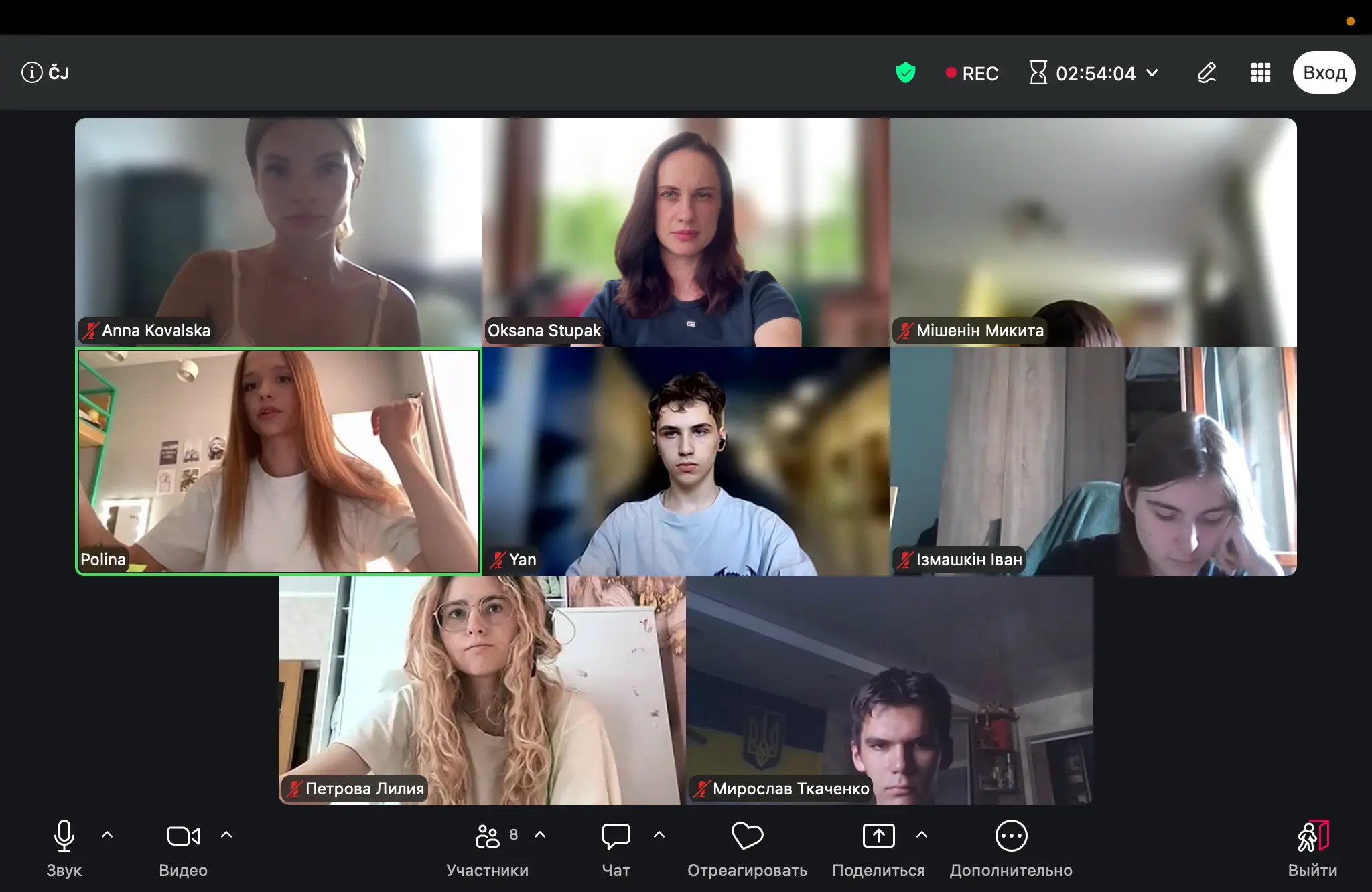
The day at the intensive Czech language courses starts at 8:00 or 9:00 am, depending on the group. The student receives a message with a link to the class on Zoom or Google Meet 10 minutes before the start. No additional preparation is required: the teacher sends all the materials to the shared chat the evening before. On the screen, the student sees a video of the teacher and the rest of the group, a shared document with the lesson materials, and a chat for short answers. A camera is required during the class. The microphone is turned on as needed: during the explanation, most students listen, during speaking practice, everyone speaks in turn.
The first 5-10 minutes of the lesson are devoted to reviewing what has been learned. The teacher asks short questions orally or via chat, and students answer. This is not a test, but a warm-up: the brain switches to Czech and remembers yesterday’s material. Online Czech courses at EdVista are built on the principle of daily repetition, as it is this that ensures long-term mastery of vocabulary and grammar. The size of groups in intensive Czech courses is small: usually from 5 to 8 students, which allows the teacher to pay attention to everyone.
Lesson structure in intensive Czech language courses
In intensive Czech language courses, one lesson lasts 90 minutes and is divided into three consecutive blocks. The first block is dedicated to the introduction of new material: a grammatical construction or a lexical topic. The teacher explains, gives examples, students listen and immediately ask questions in the chat or by voice.
The second block is dedicated to practice. Students complete exercises in real time: fill in the blanks, translate sentences, answer questions. The teacher sees the answers immediately and corrects mistakes without unnecessary delay.
The third block is devoted to conversational practice. Students receive a topic and communicate with each other or with the teacher in Czech: order coffee, describe the route, talk about weekend plans. This is the most important block for those who learn Czech online for the purpose of real use, and not just passing exams. The teacher assigns different pairs for conversational practice each time so that students do not get used to the same interlocutor. The lesson is recorded: the student can watch the recording after the lesson and hear his speech from the outside. This is one way to notice pronunciation errors that are difficult to track during a conversation on your own.
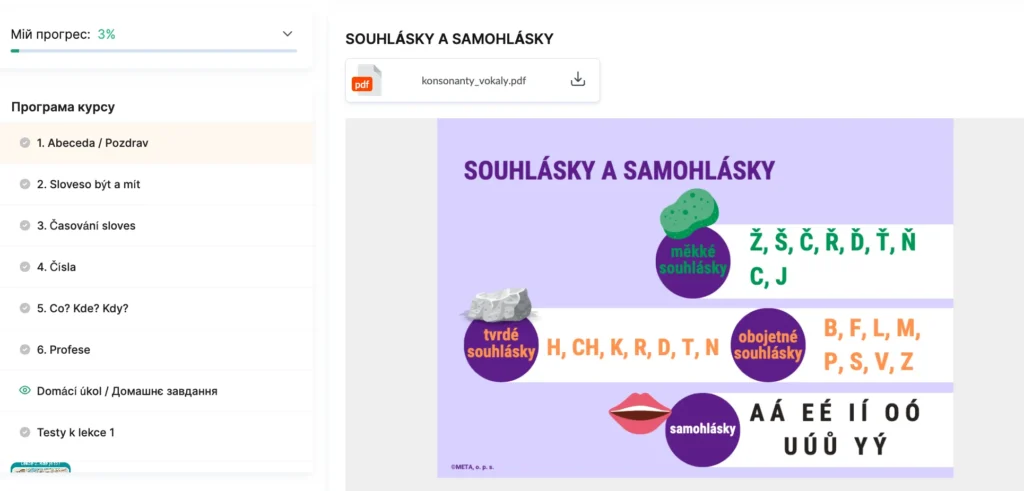
On the Kwiga platform, students can also watch videos from the teacher explaining the main important topics of Czech grammar and vocabulary. And completing quizzes and interactive tasks helps to practice the studied material.
The lesson ends with a brief summary: what was learned today and what needs to be reviewed by tomorrow. The teacher announces the homework orally and duplicates it in the chat.
It is worth mentioning separately the language of communication during classes. From level A1, classes are conducted in Czech so that students are immersed in the language environment, hearing the correct accents and pronunciation from the first lesson. This natural immersion in the language is one of the key advantages of intensive Czech language courses.
What happens between intensive Czech lessons: assignments, feedback, practice
After classes in intensive Czech language courses, students receive 20-30 minutes of homework. Usually, this is a short reading text, several grammar exercises, and one writing task: write 5-7 sentences on a given topic in Czech.
Students send completed tasks to the platform for checking by the teacher. Some tasks are in the format of quizzes: the student immediately sees the correct answer and can go through the topic several times to work it out to a confident result.
Between classes, students also have access to additional materials: audio recordings of dialogues, word lists, short videos. All this is collected on the Kwiga platform, which is accessible throughout the course. That is why intensive Czech language courses give results in 5 months: the density of contact with the material during the day is significantly higher than in classes once a week.
In addition to live classes, each student gets access to a personal chat with the teacher for urgent questions. If something is unclear after the lesson or a question arises while doing homework, the answer usually comes within a few hours. This is especially important in intensive Czech language courses, where the material accumulates quickly and an open question can slow down the assimilation of the next one.
A brief overview of the Kwiga platform from a teacher
Research in the field of foreign language learning confirms that intensive learning with a high frequency of classes produces significantly better results compared to one or two lessons per week. Learn more about the effectiveness of intensive language learning: https://www.sciencedirect.com/science/article/pii/S0346251X23001398.
What does progress look like during a week of intensive training?
During the first week, the student takes 6 to 8 90-minute lessons. This is 9 to 12 hours of pure study time plus homework. This pace explains why intensive Czech language courses produce results much faster than the standard twice-weekly format.
By the end of the first week of intensive Czech language courses, a student who started from scratch usually knows how to: greet and say goodbye, state their identity and age, ask for the price and order something in a cafe, and understand simple short texts in Czech. Students at level A2 begin to construct sentences more confidently by the end of the week and notice that they understand more of what they hear in real language.
Progress is recorded in writing: at the end of each week, the student receives a short report from the teacher with an assessment of achievements and specific recommendations for the next week. Thanks to this, the student always understands where there is improvement and where more attention is needed. After the first month of study, the teacher assesses the student’s level and, if necessary, recommends moving to the next group or additional study of specific topics.
It is important to understand that the pace of learning in intensive Czech language courses requires regularity. Missing even one lesson is noticeable in the next lesson, since each lesson builds on the previous one. That is why EdVista students are encouraged to plan their schedule in advance and report possible absences: the teacher may offer a recording of the lesson or materials for independent study.
EdVista’s learning formats are designed for different levels of preparation. Intensive Czech language courses here cover the path from complete zero to level B2, sufficient for university admission. For those who want to start from scratch or brush up on their skills, an online intensive Czech language course is suitable. If the level is already A2-B1 and the goal is to reach B2, there is a special intensive B1-B2 course for five months. For those looking for a complete path from zero to B2, a program from 0 to B2 has been developed. You can view all available formats on the online Czech language courses page.
English-language programs at Czech universities: who can enroll?
19.06.2026selector.space
English-language programs at Czech universities provide access to quality education in Europe without the need for knowledge of the Czech language. Ukrainians can enroll in bachelor’s, master’s and doctoral programs taught entirely in English and compete with applicants from all over the world on equal terms. If you are considering studying in the Czech Republic in English, it is important to understand that the requirements, deadlines and list of documents differ from Czech-language programs.
English-language programs at Czech universities: where to study
Leading Czech universities, where English-language programs of Czech universities operate, have extensive faculties for international students. Among the most popular among Ukrainians, several key institutions stand out.
Charles University (Universita Karlova) is one of the oldest universities in Europe and offers over 200 English-language programs. Medicine, law, natural sciences, social sciences: the choice is wide even for those with a clear profile. Official program page for international students: https://cuni.cz/UKEN-1.html
Masaryk University (Masarykova univerzita) in Brno is the second largest university in the country. It offers over 100 programs in English at all levels, including management, IT, law, and healthcare. More information about admissions: https://www.muni.cz/en/admissions
The Czech Technical University (ČVUT) in Prague specializes in engineering and technical specialties. English-language programs are available at the bachelor’s and master’s levels. There are also offers among universities in smaller cities: Palacký University in Olomouc, University of Pardubice, University of Harads Králové.
Areas and specialties: what you can study
English-language programs at Czech universities cover most of the relevant fields. Below are the main ones with a brief explanation of the specifics of each.
Medicine and dentistry are among the most popular areas. Charles University accepts hundreds of foreign students every year specifically for the English-language medical faculty. The study lasts 6 years and costs about 14,000 euros per year. The entrance exam covers biology and chemistry, so preparation takes time.
Economics and management are widely represented at VŠE (Prague University of Economics), Masaryk University and universities in smaller cities. Programs are available at bachelor’s and master’s levels. Tuition fees are lower than at medical schools, ranging from 3,000 to 6,000 euros per year.
Law and social sciences are mainly offered at master’s level. Bachelor’s programs in law in English are less common and are only offered at a few universities.
Technical and IT specialties are represented at FIT ČVUT and the Brno Technical Faculties. Competition is strong, but admission requirements are more predictable than for medical programs.
Natural sciences, chemistry, biology and ecology are available at several universities and are especially relevant for those planning to enter doctoral studies. It is also worth noting that some universities offer double degree programs in cooperation with universities in other EU countries. This allows you to obtain two degrees during one study period and significantly expands employment opportunities after graduation both in the Czech Republic and abroad.
Admission requirements for English-language programs at Czech universities
Admission to English-language programs at Czech universities involves three mandatory components: language level, package of documents and compliance with deadlines.
Language level
Most universities require a certificate of level B2 or C1 according to the CEFR. They accept IELTS from 6.0, TOEFL iBT from 79, Cambridge B2 First or C1 Advanced. Some universities have their own language exams. If you studied entirely in English at school or another university, some of them accept an official letter from the educational institution instead of a certificate.
Documents to submit
The standard package includes a certificate or diploma of previous education with a notarized translation into Czech or English, an academic certificate or transcript of grades, a motivation letter, 1 to 2 letters of recommendation depending on the university, a copy of your passport and proof of payment of the entrance fee. For medical programs, the results of the entrance test in biology and chemistry are additionally required.
If you plan to submit documents yourself, consider a few practical points. First, you need to order translations of documents in advance: notarization takes from 3 to 10 business days. Second, some universities require an apostille on the certificate, so clarify this requirement in advance. Third, the motivation letter for English-language programs is written mainly in English and should correspond to the academic style.
Application deadlines
Most universities accept applications for the fall semester from November to February-March. Charles University medical programs have a deadline in February. Masaryk University opens applications in November and closes in February-March. Applications are submitted through the official university systems or centrally through IS/STAG.
Tips for submitting documents
We recommend applying early: processing documents for international students takes longer than for local students. First, order translations of documents in advance – notarization takes from 3 to 10 business days. Second, some universities require an apostille on the certificate, so clarify this requirement in advance. Third, the motivation letter for English-language programs is written mainly in English and should correspond to the academic style.
Why you should consider an English-language program alongside a Czech-language one
English-language programs at Czech universities have their own advantages and limitations compared to Czech-language ones. Understanding the differences helps you choose a strategy that suits your situation.
When an English-language program is the best choice.
If your Czech level has not yet reached B2, but time is limited, English allows you to start studying in the next admission season. This is a justified solution for those who already have a stable B2+ in English and do not want to spend a year preparing for a Czech-language program. For medical and technical specialties, an international diploma based on an English-language program also opens up wider opportunities for further work in other EU countries.
When is it better to choose a Czech-language program?
If you are already in the Czech Republic and plan to stay here, the Czech language is a strategic asset. Czech-language programs are usually free for students, while English-language programs cost from 3,000 to 15,000 euros per year, depending on the university and specialty. Knowledge of Czech also simplifies adaptation, job search, and interaction with government agencies.
What if you combine both ways.
The best option for many Ukrainians is to prepare for the Czech-language and English-language programs in parallel. This increases the chances of admission and leaves the choice after receiving the results. If you are planning to enter a Czech university and want to understand the details without mistakes, contact EdVista: we help with preparation for both formats and know the requirements of each university.
For those who are still at the beginning of their journey and are considering Czech language preparation in parallel with English-language admission, there is an online intensive B1-B2 for five months. Students just starting to learn Czech from scratch will find an online intensive to be the right fit. More details about document requirements and application deadlines can be found on the Czech university admission page. If you are already preparing for a specific exam, see the university admission section.
Class of 2026: EdVista Intensive students received B2 level certificates
12.06.2026selector.space
In June 2026, EdVista held its Czech language graduation course. The students of the online intensive completed their studies, received B2 level certificates, and are now preparing to enter Czech universities. Over the course of 9 months, each participant completed 273 days of classes and 780 hours of practice with teachers.
9 months of work: what students have learned during their studies
EdVista’s online intensive Czech course is designed for those who want to achieve real results in a limited amount of time. The program covers grammar, vocabulary, listening, reading, and speaking. This is the entire basic set needed for confident admission to Czech universities.
Classes were held daily: short blocks with a teacher alternated with independent work on the materials. This format allows you to master a large volume without feeling overloaded. In 9 months, students worked through more than 780 hours of educational content and went from zero or basic level to a confident B2.
A special emphasis in the program is placed on spoken language. Students do not just study grammar from a textbook, but practice live speech with teachers and among themselves. Regular conversation classes provide an opportunity to express themselves freely in the first months after the start of the course. At the same time, written exercises and tests after each module allow you to consolidate the material and track your own progress.
It is important that the course also takes into account the practical aspect of moving and studying abroad. Students received information about the cultural characteristics of the Czech Republic, the healthcare system and student life. All this helps to prepare not only linguistically, but also practically.
The program includes not only language training. Students learn how the education system in the Czech Republic works, what nostrification is, how to apply to universities and what to expect in the first year. Preparation for admission to Czech universities is organically woven into the study from the first weeks, and is not left for later.
Czech B2 allows you to enter most Czech universities as a foreign applicant. EdVista students reach this level through a structured program, regular classes, and constant conversational practice. More information about the format is written on the page One-Year Intensive Czech Language Course.
Czech language course graduation: how certificates were awarded
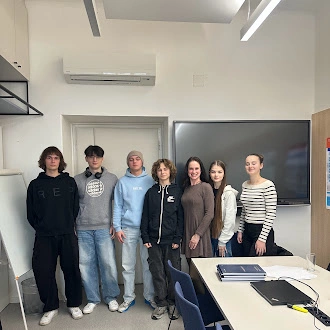
The event took place offline in the office in Brno. Each student received an EdVista certificate confirming the completion of the course and the achievement of the B2 level. For many participants, this is the first official document of knowledge of the Czech language at a level sufficient for studying at a higher education institution in the Czech Republic.
The EdVista certificate is not a state exam. However, it confirms the real amount of training: 780 hours of practice, 9 months of regular classes and a verified level of language competence. This document is useful when applying to university or when transferring to the next level.
At the graduation, students had the opportunity to communicate with each other and with their teachers, summarize their results, and share their plans for admission. Each participant came to this day with a different starting level and pace. But the result was the same for everyone: knowledge of the language and a willingness to move on.
For some students, this day was a confirmation that the decision made a year ago was the right one. Online learning requires discipline and self-organization, so completing the course in itself is a serious achievement. The certificate received confirms this.
The program also included final exams at the end of each learning block. Students did not simply “pass” the material, but confirmed their knowledge at each stage. This ensured that by the final lesson, all participants had a uniform understanding of the material, and there were no gaps in individual topics.
The atmosphere was both working and warm at the same time. This format encourages participants to continue their studies or immediately move on to practical steps of entry.
Photos and impressions from the graduation ceremony appeared on the EdVista Instagram account. Announcements of upcoming streams and current news about the course are also published there.
Where do intensive graduates enter?
After reaching the B2 level, admission to Czech universities becomes a real step for Ukrainians, not a distant prospect. Some EdVista graduates have already applied to Czech universities: technical, humanitarian, and medical. Others have chosen a master’s degree or a parallel transfer from a Ukrainian university.
The most popular majors among graduates are: information technology, engineering, management, economics, medicine, and pharmacy. Each major has its own requirements for the entry level of the language, additional exams, and documents. It is better to be aware of these differences in advance, while studying on the course.
Czech universities accept foreigners on the condition of a confirmed level of language and a nostrified certificate or diploma. Nostrification is the procedure for recognizing a Ukrainian educational document by the Czech side. It takes several months, so it should be started in parallel with studies, and not after receiving the certificate.
It is also worth considering that language level requirements depend on the specific university and faculty. Some programs accept B1, others require B2 or higher. Therefore, before applying, it is recommended to check the conditions directly on the website of the chosen university. EdVista teachers have experience preparing students for admission and can explain what exactly is tested on the entrance language exam.
More information about the admission process and required documents is written on the page admission to Czech universities for Ukrainians.
According to the studyin.cz portal, the number of Ukrainian students in Czech universities is steadily growing every year. Prepared applicants with a confirmed B2 level have a real chance of passing the competition even to popular universities in the country. The key factor for success is timely preparation: the earlier you start studying, the more time you have for nostrification and preparation of documents.
Do you want the same? The next set is already open
The next Czech language course graduation will take place 9 months after the start of the new stream. If you want to be among those who will receive a B2 certificate and real preparation for entering Czech universities, now is the time to apply for an online intensive Czech language course.
The next Czech language course graduation will take place 9 months after the start of the new stream. If you want to be among those who will receive a B2 certificate and real preparation for entering Czech universities, now is the time to apply for the online intensive Czech language course. The enrollment is open on a permanent basis: a new stream is launched every 2 months. Groups are formed up to 10 students, so places go quickly.
The course is suitable for both those who are just starting to learn Czech and those who already have a base and want to reach level B2. The teachers select the pace and materials according to the starting level of each participant. This allows you to move effectively without unnecessary repetition of already known material.
The training format is completely online, so you can join from anywhere in the world. The class schedule is agreed with the participants before the course begins. All training materials are provided within the program.
The detailed program, class schedule, and participation conditions are collected on the online intensive page. Places in the groups are limited, so it is worth applying in advance to get into a convenient stream.
Entry to the Czech Republic in 2027: when to start Czech, documents and choice of university
28.05.2026selector.space
If entry the Czech Republic in 2027 is your goal, you should start preparing no later than mid-2025. The critical path consists of three parallel processes: achieving the B2 level in the Czech language, nostrification of the certificate or diploma, and choosing a university with a specialty. Unlike the situation with entry in 4-5 months, the horizon of 12-18 months allows you to build your preparation consistently and without haste, but only if you start on time.
Entry to the Czech Republic in 2027: from what point to count the preparation
Most Czech universities open entry campaigns in November-December and close the acceptance of documents in February-March. This means that for entry in 2027, the submission of applications falls on the winter of 2026-2027. From this point we count backwards.
By the time of application you must have:
confirmed language level B2 (certificate or entrance test result)
completed nostrification of certificate or diploma
ready motivation letter
defined list of universities and specialties
If you start in mid-2025, there are 18 months until the winter of 2026-2027. This is a comfortable horizon during which each process can be launched at the right moment, and not simultaneously in a state of rush.
If the start falls on the beginning of 2026, there are 12 months left. This is still realistic, but it involves a tighter schedule and less opportunity for adjustment.
Students in grades 9-10 who are reading this article now are in the best position: time allows not only to prepare, but also to consciously choose a direction and city, without sacrificing the quality of the decision for the sake of speed. With an 18-month horizon, you can first test yourself in the environment, for example, through a summer school or an online intensive, and only then fix the final choice. This approach reduces the risk of changing your decision in the midst of the admissions campaign.
Czech to B2: how much time to take and which format to choose
Level B2 in Czech is a mandatory requirement for most state universities in the Czech Republic. The form of confirmation depends on the university: some accept a state certificate (zkouška z češtiny na úrovni B2), others conduct their own testing.
Real terms from zero to B2 for a Ukrainian-speaking student:
from A0: 12-14 months with classes of 1.5-2 hours daily
from A1-A2: 8-10 months
from B1: 4-6 months
These terms are confirmed by the practice of preparing for entry to Czech universities among Ukrainian-speaking applicants.
For those who start in 2025 with a zero level, the optimal route: an online intensive Czech language course with a gradual increase in pace. The online format allows you to study at a convenient time and is not tied to your place of residence.
An important nuance that is often ignored: the language level and preparation for the exam are two different tasks. You can have a real B2 level and not pass the exam due to ignorance of its format. You need to prepare for a specific exam separately, without expecting that knowledge of the language will automatically convert into a result.
Another point: if you choose between the online format and a face-to-face course, consider not only the number of hours, but also conversational practice. B2 involves confident oral speech, and without a regular conversational component, it is more difficult to reach this level even with a large number of grammar exercises.
With a 12-18 month horizon, it is possible to build a pace that is not exhausting. This is a significant advantage compared to an intensive 5-7 month program: less risk of burnout, more time to consolidate each level before moving on to the next.
Documents and nostrification: when to start in parallel with the language
Nostrification is the official recognition of your certificate or diploma by Czech authorities. Without it, it is impossible to apply to a university. The process takes from 1 to 4 months, depending on the type of document and the workload of the regional education authority.
application to the regional education authority or university
description of the study program (for a diploma)
When planning to enroll in 2027, the optimal time to start nostrification is the first half of 2026. This gives a margin of 2-3 months for possible delays and leaves time to correct errors in the documents.
In parallel with nostrification, it is worth collecting the entire package of documents for the university: copies of the certificate, photos, medical certificates (if required). Each university has its own list, so you need to check the requirements on the official website or through the DZS service.
An important detail: nostrification in the Czech Republic can be ordered through the entrance preparation service, and not to do it yourself. This reduces the time spent searching for notaries, translators, and understanding regional differences in the procedure.
A typical mistake with a long planning horizon: postponing nostrification until “later” because there is plenty of time. In practice, these months disappear unnoticed. It is better to collect and submit documents at the planned moment, and not when all other steps have already been completed.
How to choose a university and a specialty for entry to the Czech Republic in 2027
Choosing a university with a long planning horizon is a completely different process than with urgent entry. There is time to compare, consult and test the decision in a real environment.
The Czech Republic has over 70 accredited higher education institutions. For entry in 2027, the selection process should be organized into several steps.
Step 1. Determine the city. Prague, Brno, Ostrava, Olomouc have different levels of costs, different labor markets and different atmospheres. The city affects household logistics, opportunities for part-time work and the quality of the educational environment.
Step 2. Determine the direction. To do this, you should take a career orientation test before starting to collect documents. Changing direction after the start of nostrification is not a disaster, but it is time-consuming.
Step 3. Check the entrance requirements. Some specialties have additional entrance exams or creative competitions. You need to know about them a year in advance, not a month in advance. Detailed material on how to choose a university and specialty in the Czech Republic 9 months before admission helps to structure this choice.
Step 4. Make a list of 3-5 options. One university on the list is a risk. Three to five give a margin and the opportunity to compare conditions.
Up-to-date information about application deadlines is published on the official websites of universities. For example, the Masaryk University admission page contains deadlines, language requirements and a list of documents for foreign applicants.
If you want to go the whole route with support, comprehensive support for admission to Czech universities covers program selection, deadline control, language training and assistance with documents in a single format. For those who start in advance, this is the most effective way not to waste time correcting errors that could have been avoided.
Entry to the Czech Republic in 2027 is not an urgent task when starting in 2025. This is a planning task, where every month spent correctly brings you closer to the result without stress and haste. If you are just starting to think about joining the Czech Republic in 2027, a detailed step-by-step preparation plan with deadlines and formats will help you understand where to start.
Czech to B2 for entry: which route to choose after 10-11th grade
21.05.2026selector.space
Czech to B2 for entry after 10-11th grade is realistic in 5-12 months: the terms depend on the current language level and the format of study. A graduate without knowledge of Czech will need more time than someone who already has a base of A1-A2. The route is chosen once: if you choose too slow a pace, the admission campaign will simply end before the language level is ready. Next: specific terms, formats and steps that help you go through this path without unnecessary stops.
Czech to B2 for entry: how much time is really needed
The guideline is simple: CEFR level B2 in Czech requires 600 to 800 hours of study for a native speaker of a Slavic language. For a Ukrainian-speaking student, this is less than for an English-speaking student, but it still requires systematic work without long breaks.
The actual time depends on the starting level:
From zero (A0) to B2: 10 to 14 months with daily classes of 1.5-2 hours
From level A1-A2 to B2: 6 to 9 months
From level B1 to B2: 4 to 6 months
These terms are confirmed by the practice of preparing for entry to Czech universities: students who study systematically and without long breaks reach B2 within the specified time.
It is important to understand: universities check the language level differently. Some accept a state exam certificate (zkouška z češtiny), others conduct their own testing when submitting documents. Specific requirements should be checked on the official website of the chosen university or through the DZS (Dům zahradní spolupráce), a state body that coordinates academic mobility in the Czech Republic.
There is another nuance. Language knowledge at level B2 and confirmation of this level with a certificate are different things. The exam has its own format, and you need to prepare for it separately, and not expect that the language level will “automatically” convert into a result.
Online intensive or year-long course: what is suitable after school
After graduating from grade 11, most applicants have a clear time frame: summer plus autumn until the start of the entry campaign. It is this period that determines which format is suitable.
Online intensive Czech language: for those who have 5-7 months
The online intensive Czech language is designed for those who already have level A2-B1 and want to reach B2 in 5 months. The format allows you to study from anywhere in the world, adjust your schedule to suit yourself and prepare documents for entry at the same time.
What a typical intensive includes:
grammar and vocabulary at level B1-B2
conversational classes with a teacher
preparation for a specific language exam format
feedback on written work
If you start at B1, the online intensive B1-B2 will cover the language requirement for the start of the entry campaign at most universities in 5 months. This is the shortest route for those who already have a base.
One-year intensive Czech language course: for those starting from scratch or A1
The one-year intensive Czech language course is suitable for those who plan to enter in a year and want to go from scratch to B2 without rushing. This is a structured route, where each month has a specific result: A1, A2, B1, B2.
The one-year format gives more time to consolidate the material, practice speaking and prepare for the exam. It is suitable for graduates of grades 10-11 who have not yet decided on a specialty or are planning to enter the autumn stream of the next academic year.
If you are currently in grade 10 and plan to enter after grade 11, the one-year course gives you a margin of time and reduces the risk of not being able to keep up with the language. If you have already finished school and want to enter next season, focus on intensive formats.
What is included in the preparation for B2 for entry besides grammar
A common mistake: focusing only on grammar and vocabulary. B2 is a level that requires the ability to conduct a discussion, understand academic texts and write detailed answers in Czech.
Full-fledged preparation of the Czech language to B2 includes four components.
Conversational practice. Live speaking cannot be replaced by tests. Regular classes with a teacher, participation in conversation clubs are separate work that takes time and is not replaced by grammar exercises.
Listening. University lectures are given in live Czech, not textbook Czech. You need to train the perception of different accents and speech rates in advance, and not in the classroom.
Academic writing. Some universities test writing skills during the entrance test. The ability to structure an answer of 150-200 words is a separate skill that needs to be trained.
Preparing for the exam. The format of the B2 exam varies depending on which certificate the university requires. You need to prepare for a specific format, not a general one. More details about how long it actually takes to learn Czech up to B2 are described in a separate article.
How to combine studying Czech with preparing documents
Simultaneous preparation of language and documents is not an exception, it is the norm for most applicants. The main rule: these processes should not block each other.
While language preparation is in progress, it is worth:
collecting documents for nostrification of the certificate (terms: 1-4 months)
determine the list of universities and check the deadlines for submitting applications
prepare a motivation letter or start writing it
Some of these steps do not require knowledge of the language at the B2 level. Nostrification can be initiated in the first months of study, there is no need to wait for the end of the course.
If you want to go this way without the risk of missing deadlines, consider comprehensive support for admission to Czech universities: it includes control of deadlines, assistance with documents and coordination of all steps in parallel.
An indicative route for a graduate of grades 10-11
May-June: determining the language level through entrance testing, choosing a study format, starting preparation.
June-August: submitting documents for nostrification of the certificate, narrowing the list of universities and specialties.
September-November: active language preparation, preparation of a motivation letter, final choice of university.
December-February: taking a language exam with confirmation of level B2, submitting applications to universities.
This schedule is realistic for those starting from level A2-B1. For a start from scratch, the route is shifted a year earlier or requires a more intensive pace.
Czech to B2 for admission and preparation of documents are two tasks that are solved in parallel. Whoever understands this at the beginning does not waste time correcting mistakes in April, when the deadlines are already closing.
Summer school in Brno for applicants: who is suitable before admission
14.05.2026selector.space
Summer school in Brno is suitable for applicants who have not yet decided on a university or want to test themselves in a real student environment before submitting documents. Two weeks in a city with over 89,000 students provide something that no online course can: live language immersion, getting to know university buildings, and understanding what student life in the Czech Republic really looks like. But summer school doesn’t make sense for everyone. More on who gets real results and who doesn’t.
Summer school in Brno: what is it and what does an applicant receive in 2 weeks?
The summer school in Brno for applicants combines language classes, getting to know the city’s universities, and immersion in the student environment. In two weeks, the participant receives not a certificate or a B2 level, but a context.
What is included in a typical program:
daily Czech language classes (level A2-B1 or B1-B2)
visiting university campuses
workshop or information session on admission to Czech universities
communication in the student environment
acquaintance with the city and everyday logistics
Brno is the second largest city in the Czech Republic and a recognized student center: it is home to more than 13 universities, including Masaryk University, the second largest university in the country. According to the QS Best Student Cities ranking, Brno is among the top student cities in the world. Getting there, even for two weeks, is not a tourist trip, but an exploration before the real step.
It is important to understand what the summer school does not provide. It does not replace preparation for B2 and does not accelerate nostrification. It is a tool for one specific task: to check the solution and fill it with content.
Who is the summer school in Brno suitable for before entering a Czech university?
There is a clear range of situations in which two weeks in Brno really pay off.
You choose between several cities or universities
If the list of candidates includes Brno next to Prague or Ostrava, a summer school allows you to experience the city from the inside, not through photos on the Internet. Campuses, transportation, prices, atmosphere, distances between buildings and everyday details: all this becomes concrete, not abstract.
You have a basic knowledge of the Czech language, but you don’t yet feel the environment
Level A2-B1 in a textbook and level A2-B1 in a live conversation with locals are different things. Summer school allows you to test yourself in real situations: ordering food, clarifying the route, talking to other participants. For many applicants, this is the first real experience of communicating in Czech outside the classroom. It is such situations that consolidate the language better than exercises: there is motivation, there is context, there is the reaction of the interlocutor.
You want to check your admissions decision before investing a year in preparation
Full preparation for admission to Czech universities takes from 6 to 14 months. This is a serious investment of time. Two weeks in Brno before the start give you the opportunity to check whether this city and this direction are right for you, without full commitment.
Who is summer school not suitable for?
It is also worth being honest about situations where two weeks in Brno do not solve the problem.
If the language level is still A0-A1, two weeks will not give language progress, only an impression. In this case, it is better to first take an online intensive Czech language course and go to Brno with a base.
If the admission campaign is already open and the deadlines are approaching, two weeks at the summer school will not compensate for the lost time for nostrification or a language exam. What is needed here is not a school, but clear preparation for admission to Czech universities with specific deadlines and priorities. The summer school is effective as a research tool, but not as a salvation from lost time.
Language, environment, university: what two weeks in Brno really give
The real outcome of the summer school consists of three layers.
Language. Daily classes keep the pace and provide new knowledge, but the main thing is conversational practice outside the classroom. Shops, cafes, transport, communication with other participants in Czech. Two weeks of such immersion give the applicant more confidence in the language than a month of online classes without practice. This does not mean that online preparation is worse, it simply solves a different task. Intensive builds the level, the school tests it in reality.
Environmental. Brno is a city where every fifth resident is a student. The official portal Study in Brno notes that 68,000 students study here every semester. Getting into this environment, even temporarily, gives the applicant a different perspective on admission: not as an administrative procedure, but as entering a specific community.
Orientation. Most applicants choose a university based on ratings and page descriptions. Online research gives an idea, but not a feeling. Getting to the campus, talking to the program participants, seeing how the space is organized and where students spend time in pairs: this is a different quality of information. Visiting the campuses and an admissions workshop translates this choice from abstraction to concreteness. After that, the strategy for choosing a university and major is formed in a completely different way. The applicant understands, for example, that Masaryk University and the University of Technology in Brno are located in different parts of the city and have different atmospheres, not just different rankings in the table.
Як поєднати літню школу з подальшою підготовкою до вступу
Summer school is most effective when it is part of the overall training plan, and not separate from it.
The optimal logic looks like this. Before summer school: a language base at level A2-B1 and preliminary determination of the direction. During school: testing yourself in the environment, visiting campuses, clarifying your choice. After school: starting or continuing training for B2 and parallel collection of documents for nostrification.
If you start in 2025 and plan to enter the Czech Republic in 2026, the summer school in the summer of 2025 is a logical point on the route. It takes two weeks, but saves time at a later stage, when decisions need to be made quickly. An applicant who has already been to Brno does not spend the autumn in doubt: the city, format, university – everything is no longer an abstraction.
For those who want to make a complete preparation plan from language to application, there is comprehensive support for admission to Czech universities. It covers the choice of university and specialty, deadline control, assistance with documents and language preparation in a single route.
The summer school in Brno is not an independent admission tool. It is one step in a well-planned route, which has a beginning, middle and final point in the form of submitted documents. Where this step falls in your plan depends on your current language level, your schedule, and how clear you already are about where you want to study. The earlier you decide, the more efficient the school will be.
Entry into the Czech Republic in 2026: where to start if the start is in May
07.05.2026selector.space
If you are planning to entry the Czech Republic in 2026 and start in May, you have 4 to 7 months before the opening of admission campaigns of most universities. This is enough to complete the language level, collect a package of documents and submit an application without haste, but only if you take parallel actions in several directions at once. Next is the practical logic of preparation: what to do, in what sequence and why now.
What needs to be done before joining the Czech Republic in 2026
Preparation consists of three processes that take place simultaneously: language, documents, and university selection. The mistake of most applicants is to start by choosing a specialty without understanding their language level and how long nostrification will take. Let’s consider each direction separately.
Language
Most Czech state universities require a B2 level of Czech. From level A1, it can be achieved in 5-7 months with daily classes of 1.5-2 hours. From level A2-B1, 3-5 months of focused work are enough. If the level is currently zero or close to it, you should start immediately, without weeks of “preparation for preparation”.
Documents
Nostrification of a certificate or diploma takes from 1 to 4 months, depending on the region. You should start collecting documents in parallel with the language preparation, not after it. Waiting for a decision on nostrification is not a reason to stop: this time is spent on the language and choosing a university.
University and specialty
The choice should be made by October-November in order to prepare a motivation letter and take entrance exams where they are provided. Some specialties have competitive selection, and it is better to know about this in advance.
The urgency of preparation is explained simply. If you start in May and plan to enter the Czech Republic in 2026 for the spring campaign, all three processes must be completed synchronously: a language certificate, a ready-made package with nostrification, and an application to the university. A delay at any of the stages postpones admission by a year. That is why the sequence of steps is no less important than their content.
Entry to the Czech Republic in 2026: language preparation and level B2
Level B2 in Czech is not just a formal requirement for admission. The university is taught in Czech, and a weak level means difficulties from the first semester: difficult lectures, written assignments, communication with the administration. The university may require a language certificate or check the level during the entrance test.
What to do in May:
Sign up for an online intensive Czech course as early as possible. The online format gives you flexibility and allows you to study regardless of where you live.
Set a target date for taking the language exam: approximately October or November 2026. This gives you a clear deadline to which the entire class schedule is subject.
Practice live speaking in parallel with grammar: conversation club, tandem partner or conversation classes with a teacher. Grammar at level B2 is not enough, confident oral speech is needed.
If your current level is A2-B1 or lower, the 5-month online intensive B1-B2 is the optimal solution. It provides structured training focused on real communication and takes into account the typical needs of those preparing for admission.
Nostrification and documents for entry to the Czech Republic in 2026
Nostrification is the official recognition of your certificate or diploma by Czech educational authorities. Without it, it is impossible to apply to a university, so postponing this process until the fall is critical.
The standard package for nostrification in the Czech Republic includes the original and a certified copy of the certificate or diploma, a notarized translation into Czech, an application to the regional education authority, and a description of the study program (if the diploma is nostrified). The specific list depends on the type of document and the region of submission.
Deadlines: from 30 to 120 days depending on the workload of the body. In 2025-2026, the demand among Ukrainian applicants remains high, so it is better not to count on an accelerated decision. Documents for nostrification should be submitted no later than August-September in order to receive a decision before the start of the admission campaign.
Nostrification and document collection are a parallel process. While you are waiting for a decision, you can practice the language and narrow down the list of universities. The nostrification service in the Czech Republic can be ordered separately or as part of a comprehensive admission support package.
How to choose a university to enter the Czech Republic in 2026
The Czech Republic has over 70 accredited higher education institutions. To prepare for admission to Czech universities in 2026, focus on several criteria.
Language of instruction. Most state programs are conducted in Czech. English-language programs are available, but they are usually paid and have higher competition.
City. Prague, Brno, Ostrava have different levels of costs and different labor markets. The city affects the quality of the learning environment and opportunities for part-time work during studies.
Entrance requirements. Some majors have separate entrance exams or creative competitions. You should find out about them no later than October so you have time to prepare.
Accreditation and ranking. Up-to-date information on the recognition of qualifications and programs is published by the DZS (House of Foreign Cooperation), the state body responsible for international academic mobility in the Czech Republic. It is worth checking the chosen university through the DZS before making a final decision.
Most Czech universities accept applications from November to February. Starting in May gives you time to go through the entire process without rushing.
What to do in May: plan for entry to the Czech Republic in 2026
It is not too late to start in May. But it is important not to waste time on pauses between steps, because each week in May-June costs more than it seems.
Determine your current level of Czech. Free entrance testing is available at most language centers.
Sign up for a course or intensive according to your level and target exam date.
Start collecting documents for nostrification: make certified copies of the certificate, find a notary for translation, clarify in which region you will apply.
Make a list of 3-5 universities and specialties that interest you, and check the application deadlines on official websites.
Decide right away whether you will be preparing on your own or with support. Comprehensive support for admission to Czech universities includes program selection, deadline control, and assistance with documents from the beginning to the final submission.
Czech language up to B2, nostrification in the Czech Republic, and university selection: three tasks that are solved in parallel. Those who start them simultaneously in May will arrive in December with a ready-made package of documents and a confirmed language level. This is exactly the strategy that is embedded in the preparation program for those who plan to enter the Czech Republic in 2026 and want to go this way with minimal risks.
Czech language online for entry into the Czech Republic: how to build preparation
16.04.2026selector.space
Czech language online has become one of the most convenient formats for those who plan to study abroad but cannot attend classes offline. For many Ukrainian applicants, this is a real way to start preparing for admission to the Czech Republic without being tied to a city, country, or a rigid schedule.
But the online format itself does not guarantee results. It is important not just to find a course, but to understand exactly how to structure the study, what pace is needed, how long it will take to reach the desired level, and how to combine language learning with preparation for admission. This is what determines whether online Czech will become a working tool for future admission, or will remain just an attempt to “start sometime later.”
Who is the Czech language online suitable for?
The Czech language online is suitable for those who want to start or continue their preparation for admission to the Czech Republic from anywhere in the world. This format is for applicants who need a systematic program, but without the obligation to move to the Czech Republic at the start.
This option is especially convenient for those who:
lives outside the Czech Republic, but plans to enter a Czech university;
is studying at school or combining training with other classes;
wants to learn Czech at a steady pace;
does not have quality offline courses nearby;
is looking for a format where learning is related not only to the language, but also to the logic of future admission.
For many, online is the point from which the long route to B2 and further admission really begins. For those who want to compare a broader learning format, it is also useful to look at online Czech language courses for Ukrainians.
Is it realistic to learn Czech online for admission?
Yes, it is possible. But only if online learning has a clear structure, regularity and is tied to a specific goal. The problem is not in the online format itself, but in the fact that many people perceive it as something secondary: watch a lesson when they have time, do a few tasks, and then return to the topic later.
This approach does not work for admission. For an online Czech language course to really give results, you need:
a consistent learning program;
a clear route from the starting level to the next;
regular practice;
progress monitoring;
the connection of the language with future stages of entry.
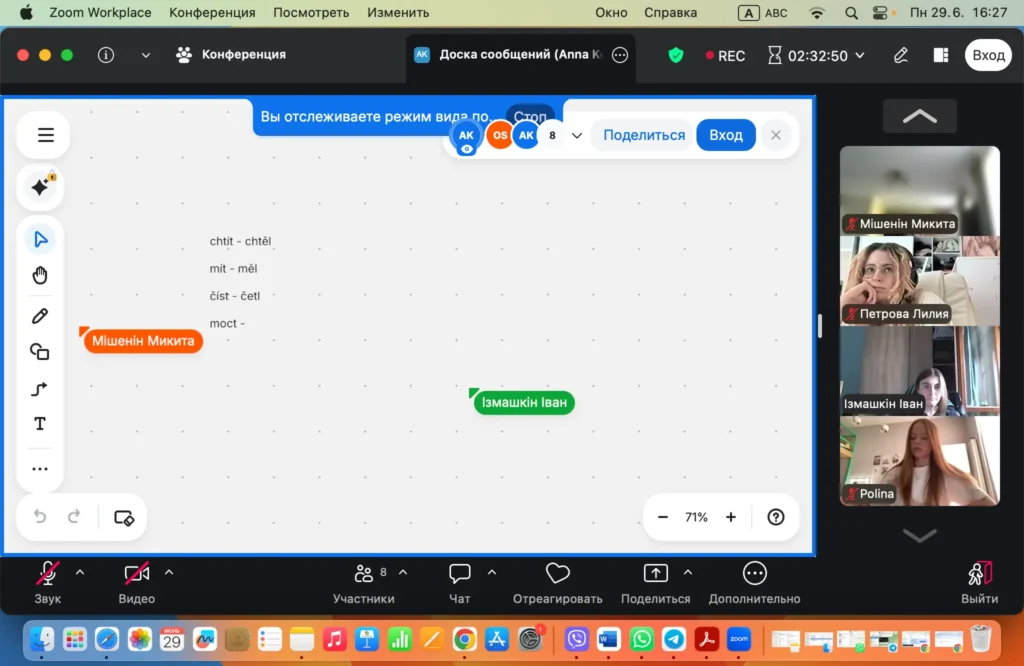
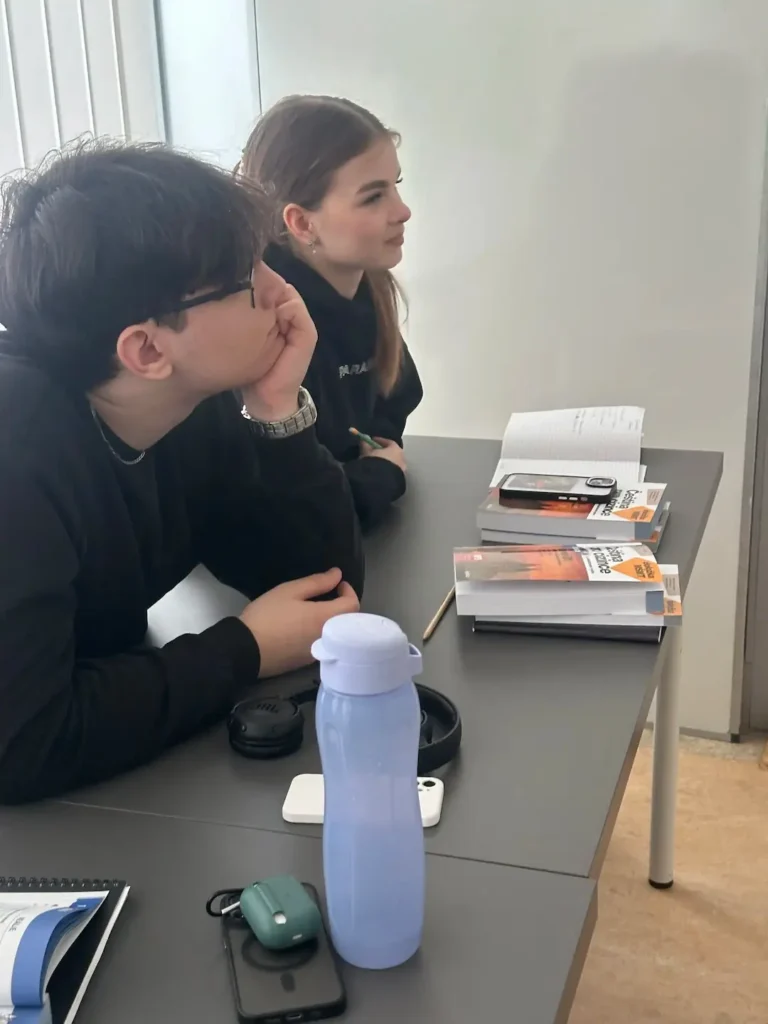
During online classes, students work with educational materials and exercises
When these elements are present, Czech online can be a complete basis for preparation. It allows you to not waste time and move towards admission even when the applicant is not yet physically in the Czech Republic.
Why it is important to not just “learn the language” for admission, but to go to the level
One of the typical mistakes is the formulation “I am learning Czech”, without understanding what level you need to reach and in what time frame. Because of this, the preparation becomes blurred: a person seems to be studying, but does not see where exactly he is moving.
For admission to the Czech Republic, it is not just the presence of the language in the applicant’s life that is important, but the movement towards a specific result. If you start from scratch, the route will be longer. If you already have A2, the structure of the study changes. If you have B1, then the emphasis shifts to bringing the language to the introductory level and further integration with preparation for the next steps.
That is why learning Czech for admission is not about separate lessons. The CEFR levels from A1 to C2 can be a reference point for such a route. It is about a system where each stage is subordinated to the final goal.
Which format works best for levels 0, A2 and B1?
Online learning works best when the format matches the starting level and the pace at which a person can realistically move forward. The training logic will be different for starting from 0, for level A2, and for level B1.
Level 0
If an applicant is starting from scratch, he needs a format with a clear base. At this stage, it is important not to rush chaotically, but to consistently cover the foundation: the alphabet, reading, basic grammar, vocabulary and listening comprehension. Online is a good start for such a program if there is regularity, explanation and control of assimilation.
Level A2
If you already have A2, learning should be structured not as a repetition of everything from the beginning, but as a movement to a stronger working level. Here it is important to expand vocabulary, work more confidently with grammar, strengthen listening and speaking. It is at this level that many people get stuck, because they learn the language without a clear transition to the next step.
Level B1
For those who already have B1, the online format is a suitable tool for building up the language to the level required for study. It is important not to just “learn a little more”, but to work on accuracy, academic communication, more complex constructions and confident use of the language in the context of future admission.
How does an online intensive differ from regular courses?
Not every online course is created equal. There is a difference between a regular “language introduction” course and a format that is geared towards a faster, more structured approach to a specific goal.
the language is perceived not as a separate subject, but as part of the route to admission.
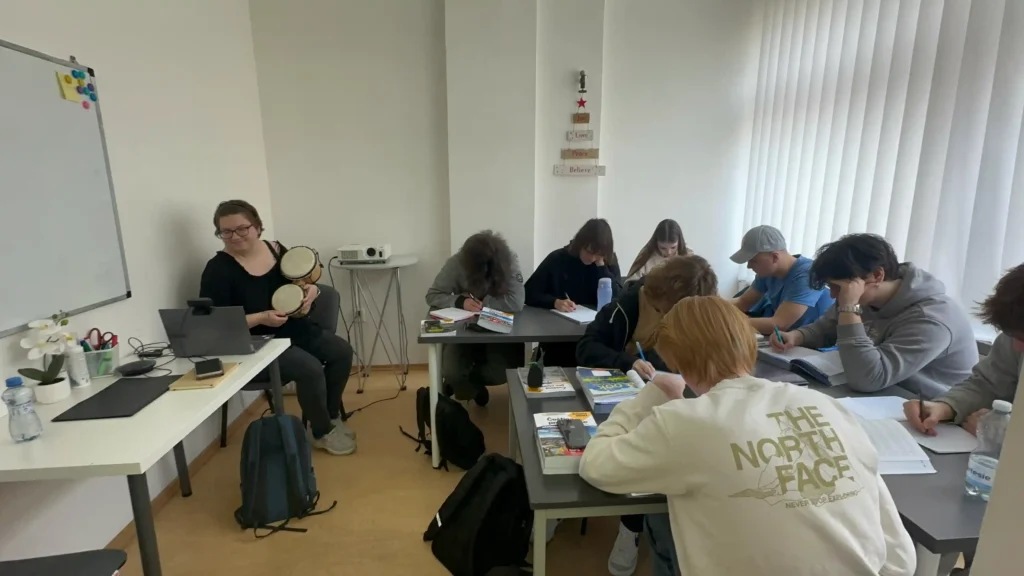
Group online lesson with a teacher during admission preparation
This format is suitable for those who do not want to stretch their preparation for an indefinite period. This is especially important for those who have a specific deadline and understand that entering a Czech university requires not just classes, but a pace that really leads to results.
How to combine online Czech language and entrance exam preparation
Learning works best when the language does not exist separately from the future admission. If a person learns Czech on their own and then separately starts to deal with universities, documents and requirements, they often waste time on asynchronous actions.
It is much more effective to combine these processes in parallel. This means:
understand what exactly the language is needed for;
When Czech online is integrated into an overall strategy, learning becomes not just useful, but applied. A person sees how each stage of language learning brings them closer to the next step.
What mistakes hinder those who learn Czech online?
Even a good format may not work if the approach to learning itself is not built correctly. Most often, applicants waste time due to the following mistakes:
irregular classes without a stable rhythm;
an attempt to learn everything at once without a system;
lack of a specific level as a goal;
changing courses and formats without completing the stages;
separation of the language from the real logic of entry;
expecting a quick result without sufficient practice.
Because of this, a person can spend a lot of time, but not feel any real progress. That is why an online Czech language course should not be a set of separate lessons, but part of a larger training system.
Who is EdVista’s online intensive suitable for?
EdVista’s online intensive is suitable for those who want to study Czech online not in a chaotic manner, but within a clear program related to the future entry into the Czech Republic. The format combines intensive online language learning, consistent movement through levels and the connection of learning with preparation for entry into Czech universities. This is a format for those who are interested not just in “having classes”, but in seeing the route and the result.
This format will be useful for those who:
wants to start learning Czech online from anywhere in the world;
has limited time and does not want to stretch out the preparation;
is looking for an intensive, structured learning pace;
wants to combine language training and orientation in the admissions process.
Students study Czech in a live online format with a teacher
The online intensive is especially powerful for those who understand that entry should not be approached in separate fragments. When learning is built as part of a holistic route, progress becomes much clearer.
Czech language online is a real start to preparing for the Czech Republic
For many applicants, online is becoming the most realistic way not to postpone preparation for later. Czech language online gives you the opportunity to start preparing for admission to the Czech Republic from anywhere in the world, move to the desired level and at the same time build your route to the university. This is an opportunity to start now, enter the language, understand your level, build a pace and take the first steps towards future admission.
Czech language online does not replace personal motivation and discipline, but provides a format in which preparation becomes accessible, flexible and systematic. And if the study is also connected with the logic of admission to the Czech Republic, it is no longer just a course, but part of the future route.
Questions about the Czech language online for entry into the Czech Republic
Is it possible to learn Czech online from scratch?
Yes. The online format is also suitable for starting from scratch, if the training is structured sequentially, with a base, practice, and progress monitoring.
Is Czech language online suitable for preparing for admission?
Yes. With the right structure, online Czech can become a complete basis for preparing for admission to the Czech Republic.
What is better for admission – a regular course or an online intensive?
It depends on your starting level, time, and goal. If you need a faster, more focused route to a specific result, an online intensive usually works better.
Is it possible to combine online language learning and entrance exam preparation?
Yes, and that’s how it works more effectively. When the language and logic of the application are combined, the applicant better understands his next steps.
Who is the online format most suitable for?
For those who want to learn Czech for Ukrainians from anywhere in the world, combine studies with other things and not waste time before the start of the introductory route.