Apostille for the Czech Republic: school diploma for admission
02.10.2026
selector.space
An apostille for the Czech Republic confirms that a foreign school diploma is genuine, so Czech authorities can accept it. International applicants need it mainly for nostrification, the official recognition of foreign education in Czechia. Universities set their own rules for admission documents. Below we explain when your diploma needs an apostille and when superlegalization applies instead. We also show the order in which to prepare the papers.
Apostille for the Czech Republic: when your school diploma needs it
Most applicants to Czech-taught programs need nostrification of their secondary school diploma. For school certificates, the application goes to the regional authority, called krajský úřad. If your permanent residence is in Prague, it goes to Prague City Hall instead.
The regional authority accepts only a legalized original or an officially certified copy of a legalized diploma. In practice this means an apostille or superlegalization, depending on where the school is accredited. The authority may also set one or more nostrification exams if your curriculum differs from the Czech one.
Admission to a university is a separate step, and a Czech Republic diploma apostille is not always required there. Each university decides whether it requires an apostille or superlegalization on documents it receives. Some universities publish lists of the required forms of document verification by country. Check the list or the admission page of every university where you apply.
Before you start, make sure you have the originals of all education documents. This includes the diploma itself and any annex or transcript with the list of subjects. If the transcript shows only grades, ask your school for a version that also lists the hours for each subject.
Countries with legal assistance treaties: the Ukrainian example
Czechia has legal assistance treaties with a number of countries. Documents covered by such treaties usually need no further verification, only an official Czech translation.
However, the Czech Ministry of Education adopted a new interpretation of selected treaties together with two other ministries. According to it, these treaties do not cover education documents. The Czech Ministry of Education publishes the list of affected treaties on its website.
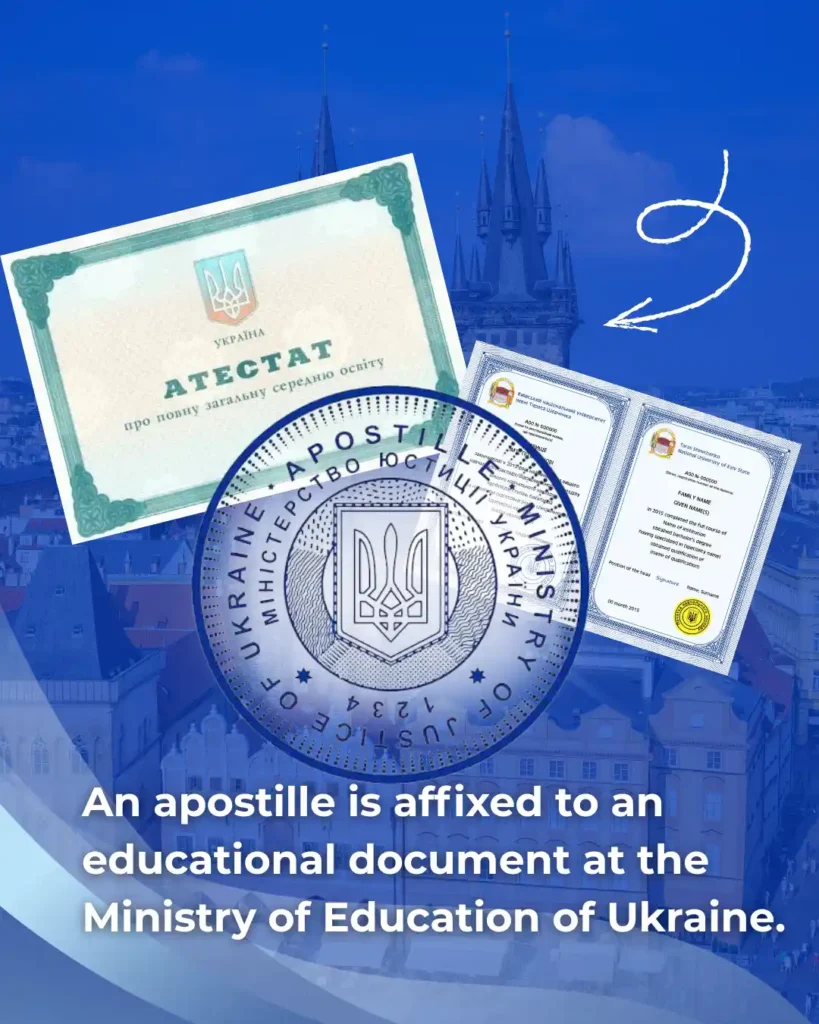
Ukraine is the clearest example. Under the new interpretation, the Czech Ukrainian treaty does not apply to school certificates. For nostrification, they must therefore carry an apostille. The Ukrainian Ministry of Education and Science places apostilles on Ukrainian education documents. Since 18 March 2026, applicants can also get an apostille on some Ukrainian documents in Prague. Dokument, a Ukrainian state enterprise, provides this service through its Passport Service.
The Olomouc Region guide describes these rules in more detail.
Apostille or superlegalization: which one applies to your country
The form of verification depends on the country where your school is accredited.
If that country is a party to the Hague Apostille Convention, your diploma needs an apostille. It is issued by the competent authority of the country that issued the document. Czech authorities do not issue apostilles on foreign diplomas.
If the country is not a party to the convention, superlegalization applies. Superlegalization for the Czech Republic usually has two stages. First, the foreign ministry or another authorized office of your country verifies the document. Then the Czech embassy or consulate in that country superlegalizes it.
What countries accept apostilles? Every party to the convention accepts them from the other parties. The current list is in the Apostille Convention status table of the Hague Conference. Check your country there before you start, because the list changes.
The Czech Ministry of the Interior summarizes all three options on its page about the Legalization of Documents Issued Abroad.
How to get an apostille on your diploma
Getting an apostille for use in the Czech Republic follows a similar pattern in most countries:
- Check in the status table whether your country is a party to the convention.
- Find the competent authority for education documents in your country. The Hague Conference publishes a list of competent authorities for every party.
- Submit the original diploma and its annex, following the rules of that authority.
- Receive the apostille stamp or certificate attached to the document.
How can I apostille my documents? Only through the authority of the country that issued them. The same applies to a Czech Republic degree apostille on a university diploma. You may need one for a master’s program.
Can an apostille be done online? Some countries issue electronic apostilles, and the Hague Conference states that an e-Apostille should not be refused just because it is electronic. Not every country offers this option, so check with your competent authority.
Can an apostille be done in one day? Processing times depend on the country and the authority. Plan this step several months before the nostrification deadline.
Apostille and nostrification in the Czech Republic: the order of steps
Once the apostille is ready, the steps for nostrification usually go in this order:
- Get the apostille or superlegalization on the original diploma and annex.
- Make an officially certified copy. A notary, a Czech POINT office or a Czech embassy can certify it.
- Order a Czech translation from a certified translator.
- Apply for nostrification at the regional authority, or at Prague City Hall.
- Submit the nostrification decision to your university.
An apostille stamp accepted in the Czech Republic does not replace nostrification. It only confirms that the document is genuine, while nostrification confirms that your education matches the Czech level. We cover deadlines and common mistakes in our guide to nostrification in the Czech Republic.
Plan the budget for these steps as well. Apostille fees, translations and certified copies add to the cost of applying. We break down these expenses in the article how much does it cost to enter a Czech university.
If you choose English-language programs, check the document requirements of each university separately. The general path for foreign applicants is described in our hub university in Czech Republic for international students.
How EdVista helps international applicants
Document rules differ between countries, universities and regional authorities. A missing apostille or the wrong type of copy can delay your application by months. Our admission support to a Czech university takes this part off your hands.
A personal coordinator checks your documents and tells you which verification your country needs. The coordinator also guides you through nostrification and helps you submit applications to the chosen universities. Support runs in three stages: university selection, preparation and enrollment.
Book a free consultation to check your documents before you start the apostille process.