Home » How long does it take to learn Czech to the B2 level?
How long does it take to learn Czech to the B2 level?
09.12.2025selector.space
Learn Czech to the B2 level is a significant achievement that opens up new opportunities in studying, work, and everyday life in the Czech Republic. It’s more than just memorizing words and rules: on average, the path to this level takes 10-15 months of intensive study. These timelines are completely realistic for those who are seriously committed to success.
Level B2 means that you can formulate your own thoughts on complex topics, understand texts of different styles and levels of difficulty, hold discussions on professional and everyday topics, and confidently interact with native speakers in work and social environments.
What does level B2 mean?
Level B2 on the CEFR scale is the stage when you can already use the language freely in most everyday situations. It is not the level of a native speaker, but it is already “adult” language proficiency, when you can not only speak, but also express yourself confidently and articulately.
In simple terms, B2 means that you can:
communicate without difficulty on everyday topics (work, travel, doctor, shopping);
talk about complex things, education, social issues, work processes;
understand movies, news, and native speakers, even when they speak quickly;
read complex texts: analytical articles, popular science materials, instructions;
write texts that look professional: essays, official letters, appeals, statements.
Why is B2 considered universal? Because at this level, a person can already fully use the language in all areas of life, not just communicate in a store. B2 is a threshold level, after which it becomes possible to study in a foreign language, listen to university lectures, work, and maintain professional communication with colleagues and clients. With this level, you will have access to virtually all opportunities: education, work, travel, and social integration. A person with B2 no longer feels the language barrier and moves from basic survival in a foreign language environment to truly active and effective communication.
Skills and capabilities of a student at the B2 level
For more accurate orientation, the Common European Framework of Reference for Languages (CEFR) is used. CEFR was launched in 2001 and became an important tool for standardizing language proficiency levels. It describes the process of mastering a language by competencies and sub-competencies using descriptors that do not depend on a specific language, which makes the system universal.
Based on this framework, you can define the main language competencies characteristic of the B2 level and the specific manifestations of these skills in speaking, reading, writing, and listening:
Grammar
The student confidently uses complex structures: conditional sentences, perfect and passive forms, reported speech. They can build extended, precise statements without unnecessary pauses.
Vocabulary
In addition to commonly used vocabulary, the student knows specialized words (education, work, society) and phraseology.
Speaking
Can participate in discussions, argue a position, express complex thoughts and emotions.
Reading
Reads articles, academic texts, journalism. Understands both the main idea and details without constantly using a dictionary.
Listening
Understands lectures, interviews, news, dialogues at a fast pace, even if unfamiliar words are present.
Writing
Can independently write correct texts: an essay (250-300 words in 30-40 minutes), business letters, a resume, and conduct official communication.
How long does it take to learn Czech?
On average (based on CEFR), you can plan on 560-670 hours of active learning. An approximate breakdown by levels looks like this:
A1: 80-100 hours.
A2: 100-120 hours.
B1: 180-200 hours.
B2: 200-250 hours.
Why is it easier for Ukrainians to learn Czech?
Czech and Ukrainian come from the Proto-Slavic language, so there are quite a few shared features between them. That’s why Czech is much easier for Ukrainians, especially at the beginner levels.
About 60% of basic vocabulary sounds similar or has a close meaning, which allows you to recognize words faster, even if you haven’t seen them before. For example: “sestra” – “сестра,” “hora” – “гора,” “voda” – “вода,” or “okno” – “вікно.” The relatedness of the languages is a big plus that makes the path to Czech much more comfortable.
How to learn Czech: a step-by-step path from zero to confident proficiency
The smartest way to master Czech is to move consistently, step by step, from the simplest to the more complex. At the EdVista educational center in Brno, we created Czech courses for Ukrainians, where you can learn with enjoyment and alongside experienced teachers. Each level is a separate stage that allows you to develop comfortably, without skipping important things.
A1: first steps in the language
Here you will get to know basic words and simple phrases you need every day. After this course you will be able to politely address people, order coffee or lunch, talk about yourself, family, home, plans for the day, and even explain how you feel.
A2: expanding possibilities
At this stage your vocabulary becomes richer and your grammar becomes stronger. You will already be able to write simple letters (both official and friendly), send emails, compose a short story about yourself, and describe what you see around you, culture, events, impressions.
B1: deepening the structure
This is where the real breakthrough happens. At the B1 level, you finally stop simply memorizing individual phrases and begin to see the internal logic of the Czech language.
At this stage, you fully understand the case system. Verb tenses, present, past, future, fit into a clear pattern. It is especially interesting when you begin to feel the difference between perfective and imperfective verbs.
Next come the conditional and imperative moods, passive constructions, and indirect speech. Yes, the list looks impressive, but you know what? When everything is presented sequentially and with a clear system, these elements cease to be intimidating and begin to fit naturally into your speech.
B2: confident proficiency
At this level, there is a qualitative leap. You are no longer just talking, you are formulating complex thoughts and participating in serious discussions at work or in your studies. You can easily understand complex articles, podcasts, and lectures. And you can not only understand, but also defend your position with the necessary arguments. And writing? You create texts of various genres, from business letters to analytics and essays.
How to choose the right class format to learn Czech?
Before you decide on a learning format, try a few options and feel which one fits best.
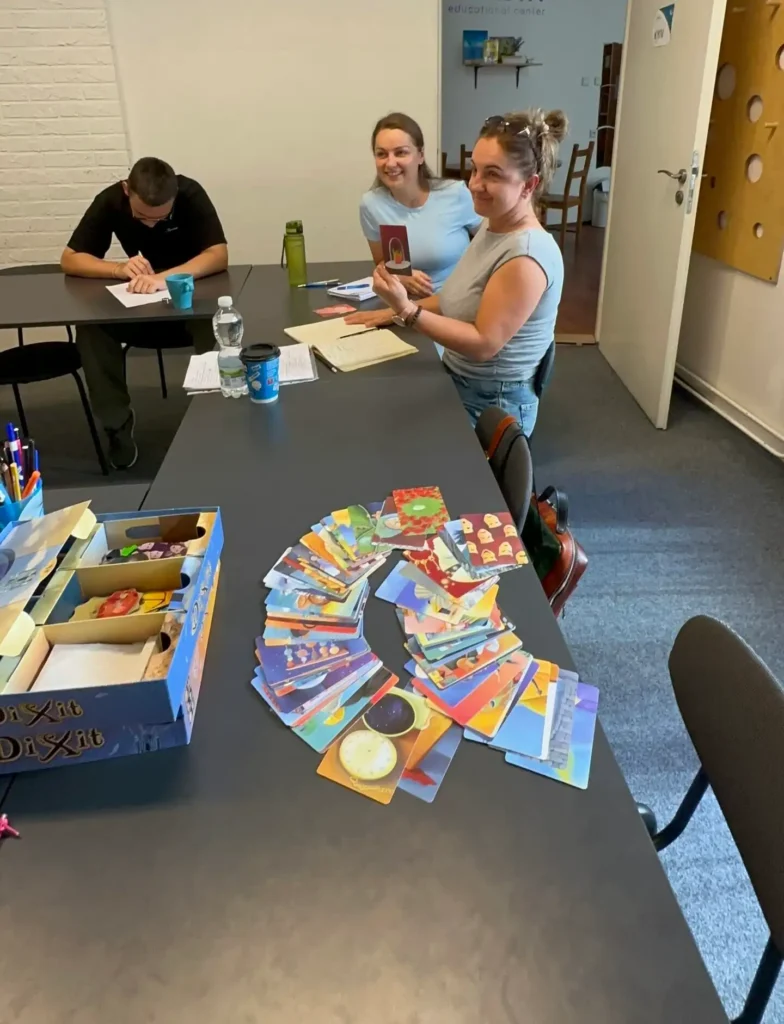
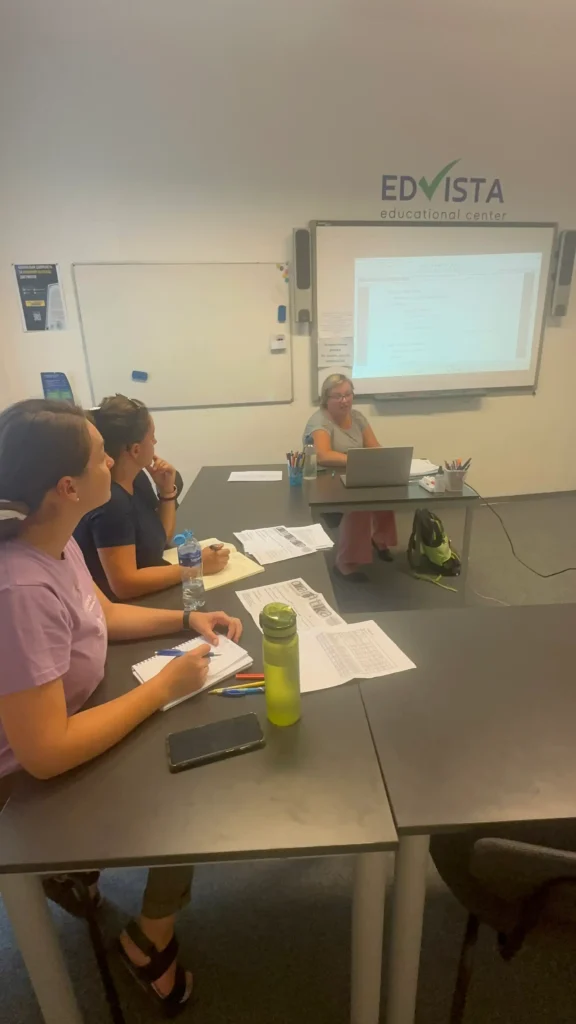
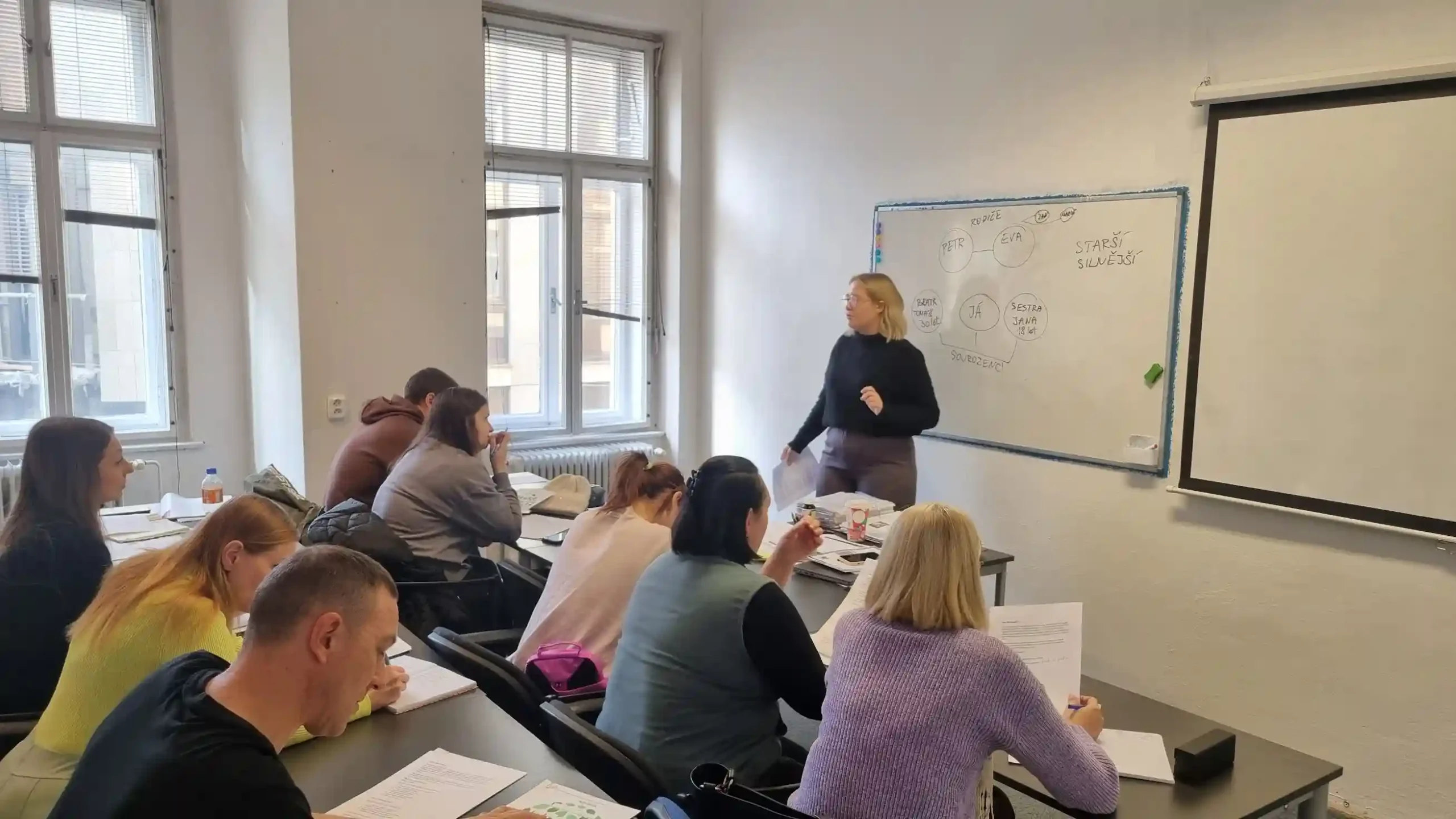
Group classes
Group classes help you overcome the language barrier faster and get regular practice. Other advantages include:
However, it’s worth considering that the pace of classes is determined by the average level of the group, so sometimes it can be slower or faster than you expect. To reinforce grammar and writing, additional independent work may be needed.
Individual courses
This is a format for those who want maximum personalization and fast progress on difficult topics. The advantages of this format are:
the program is fully tailored to your goals;
the ability to work on specific difficulties;
a flexible pace and focus on weak points;
detailed feedback in every class.
But in this format there is less live interaction with other students, so communication and exchange of experience are limited.
Self-study
Independent practice greatly strengthens any other format and gives a lot of freedom. Main advantages:
a convenient pace, when you can study at any time;
a large choice of resources: textbooks, videos, online platforms;
the ability to focus on your own interests.
However, without a teacher it’s harder to maintain motivation. The lack of constant control and correction of mistakes can slow down progress.
How to learn Czech faster?
We offer a few simple ways to speed up your learning:
It is possible to reach B2 in 8-12 months if you study intensively, or in 12-18 months at a normal pace. Of course, these figures are based on the experience of hundreds of students who have gone through this process.
What really determines success? Three things: regularity, a systematic approach, and competent support from the teacher. That is why structured Czech language courses produce such results, they take you from A1 to B2 gradually, without rush or overload. The teacher notices and corrects mistakes in time, before they become ingrained, and you get enough practice so that the language becomes a natural part of your thinking, rather than a set of memorized rules.
If you need to learn Czech for studying, work, or relocation, go to the EdVista courses page and choose the program that best matches your goals, studying, work, or relocation. Contact us: +420 770 624 146. You can also reach us through messengers that are convenient for you: Telegram and WhatsApp.
Join our social media, Instagram, Facebook, YouTube, and TikTok. We regularly share interesting cases, useful tips, and up-to-date information.