Admission to Czech universities for Ukrainians: practical steps for studying in the Czech Republic
23.12.2025selector.space
Studying in the Czech Republic means getting ready on multiple fronts. Czech at B1-B2 level is officially required for admission, but its real value shows up in everyday life, from dealing with university offices to job hunting and socializing. Those first couple months tend to be the toughest because of cultural differences and having to handle everything yourself, but most universities run support centers and orientation programs that make the transition way smoother.
Language requirements and the role of Czech in adaptation
Most public universities in the Czech Republic require foreign applicants to have a B1 or B2 level of Czech, depending on their field of study.
Why is it important to learn Czech before moving? First, a language certificate is a formal requirement for admission. Second, the language is critically important from the very first days: communicating with the university administration, moving into a dormitory, filling out paperwork, seeing a doctor, shopping, and using transportation.
For Ukrainian applicants, intensive Czech language courses are the most convenient option. They help you systematically prepare for admission in a short period of time, get used to the sound of the language, and master the necessary vocabulary. Czech language courses tailored specifically to the needs of admission relieve a significant amount of stress and boost confidence.
Studying in the Czech Republic through the eyes of Ukrainian students: adaptation, culture, and challenges
The first few weeks in a new country are the most difficult. Even with a good level of language proficiency, students encounter cultural differences: a different style of communication, formal rules, and distance between teachers and students. In the Czech Republic, independence is valued, you are expected to show initiative and responsibility.
Most universities have support centers for foreigners: adaptation programs, mentors, consultations on studying and everyday life. It is worth actively using these resources from the very first days.
Typical difficulties faced by Ukrainian students:
overestimating their own language skills;
fear of asking questions;
isolation among fellow countrymen.
To socialize more quickly, we recommend participating in student events, language tandems, and volunteer programs. The Czech language becomes much more accessible to Ukrainians when it goes beyond the textbook.
Living in the Czech Republic while studying: accommodation, transport, expenses
Accommodation and daily expenses. Most students start out living in university dormitories when they arrive in the Czech Republic. This is because it is a very economical and practical option. Living in a dormitory is cheaper than renting a room or apartment.
Student expenses. On average, a student in the Czech Republic needs 10,000-15,000 crowns per month. But of course, it still depends on the city and lifestyle. Accommodation usually costs 4,000-8,000 korunas, and food costs around 4,000-6,000 Czech korunas. Additional expenses, such as transportation, communications, and small necessities, will cost approximately 2,000-3,000 korunas.
Transportation and mobility. The Czech Republic has a very accessible infrastructure, and its public transportation systems are considered among the best in Europe. Students, in turn, can receive up to a 75% discount on travel passes. This makes travel within and between cities affordable, even on a limited budget.
Health insurance. If you are going to the Czech Republic as a student, be sure to pay attention to health insurance, as it is mandatory. Without valid insurance, you will not be able to obtain a student visa and legally stay in the country during your studies.
How to choose a university and study program in the Czech Republic?
Choosing a study program is a very important step that can influence your future profession and career growth. But choosing a university is just as important, especially for foreigners. This is because it determines the conditions of study and the level of support you will receive.
First of all, you need to clearly define what you are really interested in. Humanities, technical disciplines, economics, medicine, or something else. In the Czech Republic, even the same study program can vary dramatically from one university to another. In terms of the program, practical component, requirements for students, or language of instruction.
When choosing a university, pay attention to the following points:
the language in which you will be taught (Czech or English) and what the language proficiency requirements are;
whether the university has experience working with foreign students, whether there are preparatory courses or adaptation programs;
the reputation and specialization of the university;
it is also important to pay attention to the city where you are going to study, the conditions there, the cost of living, and whether there are opportunities for part-time work or internships.
Don’t forget that informed choices are highly valued in the Czech Republic. Universities will expect you to understand why you chose a particular major. Or why you chose them among the wide variety of educational institutions available. Therefore, it is worth comparing several options in advance, studying the curricula, and realistically assessing your language skills and academic abilities.
Documents and mandatory formalities for students
To prepare for admission to Czech universities, you usually need:
a certificate or diploma with an appendix;
nostrification (recognition of education);
language certificate;
motivation letter (for certain programs);
entrance exams or tests.
A separate issue is a visa or long-term residence permit for the purpose of study. The process takes time, clear deadlines, and the correct set of documents.
Upon arrival, students are required to:
register their place of residence;
take out or confirm insurance;
open a bank account;
notify the university of their arrival.
Typical mistakes made by Ukrainians include missed deadlines, incorrect translations of documents, and underestimating language requirements. That is why consulting with specialists significantly reduces risks.
How life changes after the first year of study in the Czech Republic?
After a year, most students notice radical changes. Knowledge of the Czech language opens up access to part-time jobs in their field, paid internships, and better integration into the academic environment.
Students find it easier to change their field of study, transfer to other programs, or plan for a master’s degree. A realistic vision of the future emerges: working in the Czech Republic, long-term residence, permanent residence.
The Czech language ceases to be a barrier and becomes a tool for study, career, and everyday life.
Successful study in the Czech Republic begins with language and preparation
Studying in the Czech Republic is not a spontaneous decision, but a process that requires preparation. The key factors for success are clear planning, the right documents, and, above all, the Czech language.
By investing time in learning Czech, especially through intensive Czech language courses, you significantly increase your chances not only of admission but also of a comfortable student life in the Czech Republic.
If you are planning to study abroad and want to avoid common mistakes, it is worth starting with a proven step, choosing high-quality Czech language courses or getting professional advice on admission. Preparation today means peace of mind and opportunities tomorrow. Call +420 770 624 146. You can also contact us via messengers: Telegram and WhatsApp.
Join our social networks, Instagram, Facebook, and TikTok. We regularly share interesting cases, useful tips, and relevant information.
Why learning Czech is important for Ukrainians: advantages for work, study, and immigration
16.12.2025selector.space
Learning Czech opens up access to significantly better living conditions for Ukrainians in the Czech Republic and throughout the European Union. Knowing Czech allows you to apply for higher salaries and better jobs, study for free at state universities, confidently solve everyday issues from renting accommodation to communicating with doctors, and most importantly, adapt more quickly to a new country without constantly relying on translators and intermediaries. Thanks to the similarity of the languages, Ukrainians learn Czech much more easily than other European languages and can communicate freely on everyday topics after just a few months.
Advantages of knowing Czech for work
Higher salaries and better contracts. Employees who speak Czech at the A2-B1 level have significantly more opportunities in the labor market. Knowledge of the language allows you to apply for a wider range of vacancies, communicate directly with the employer, and count on more transparent and favorable terms of cooperation. It also opens the way to work and simplifies the process of drawing up an official employment contract.
Working without intermediaries means fewer risks. Knowing Czech allows you to communicate with your employer directly, without intermediaries or language barriers. You can sign employment contracts yourself, clearly understand their terms and conditions, and avoid typical mistakes and risks associated with labor migration.
Faster career growth. Foreigners who live in the Czech Republic and know Czech are more likely to advance their careers faster. Knowing the language allows you to participate in training and educational programs, as well as confidently perform new tasks. This helps you get noticed by your employer, get interesting projects, and get promoted.
What are the advantages of learning Czech?
It is easier to understand materials and lectures, you will master academic disciplines faster because the materials and explanations provided by teachers are available in your native language. This is especially important for majors that are popular among Ukrainians. Business and law, social sciences, IT and technology, culture and art, as well as engineering and construction.
Free education at public universities, knowledge of the language allows you to study at public expense, use all educational resources, and integrate into the student environment more quickly.
Easier adaptation to the student environment, the better you know Czech, the easier it will be to get used to new conditions. You will understand teachers faster, communicate more easily with your classmates, actively participate in student life, and solve everyday problems without any problems.
To make emigration easier, it is worth learning Czech
Even when the country is friendly towards foreigners, the first few months can be difficult: everything works differently, and familiar activities require more time and attention. Knowing the language has many advantages:
Confidence in everyday situations. Knowing Czech helps you feel more relaxed in everyday situations: in shops, on public transport, when visiting the doctor or using services.
Easier interaction with institutions. With the language, it is easier to understand documents and the requirements of state authorities. You understand better what is required of you and can communicate directly with representatives of institutions without the constant help of interpreters.
Live communication and adaptation. Even basic Czech makes it easier to meet and communicate with locals. This helps you integrate into the environment more quickly and not feel isolated. Understanding the language allows you to perceive the culture, traditions, and everyday life of the Czech Republic, rather than just orienting yourself on a superficial level.
Why is Czech considered one of the easiest languages for Ukrainians to learn?
Many Czech words are already familiar to you intuitively: máma – mother, rodina – family, práce – work, škola – school. Right from the start, you will be able to recognize words on signs, menus, documents, or in conversations.
Both languages belong to the Slavic group, so they have similar cases, tenses, and sentence structure. Although Czech has its own nuances, Ukrainians find it easier to learn its grammar rules than, for example, English or German.
And another advantage: progress at the first levels is very noticeable. After a few months, you will already be able to communicate on everyday topics, read simple texts, and find your way around shops, transport, and documents.
Practical advantages: why learn Czech?
Renting accommodation and communicating with landlords. Most ads are in Czech, and when you understand the language, renting becomes much easier. You can negotiate directly with the landlord, avoid overpaying, and clearly understand the terms of the contract, such as who pays for utilities or repairs.
Everyday matters and services. Czech makes it easy to deal with everyday issues. You will be able to make a doctor’s appointment, open a bank account, connect to the internet or get a SIM card, and fill out paperwork for kindergarten or school. In addition, knowing the language makes it easier to pay bills and use online services, as well as order repairs for appliances, plumbing, or computers without outside help.
Transportation and travel. Knowing the language makes traveling around the country more comfortable. You will be able to read train and bus schedules, buy tickets online or at the ticket office without mistakes, as well as easily find your way around stations and ask people for directions.
Social integration and networking. Once you learn Czech, it will be much easier for you to make new friends. You will also be able to participate in various events, clubs, or hobbies. You will feel like a part of society rather than dependent on translators.
Safety and confidence. Knowing the language not only gives you confidence in critical situations, but also allows you to calmly explain what happened to you. It doesn’t matter who you’re talking to, whether it’s an ambulance, the police, or the fire department. You will speak clearly, which reduces the risk of being misunderstood and ultimately makes your life safer.
What is the easiest way for Ukrainians to start learning Czech?
Starting to learn Czech online is easy and convenient, even if you have a busy schedule. However, it can be difficult to plan your own individual learning program. That’s why we recommend getting help and choosing an experienced teacher who will tailor the program to your goals and level, recommend effective resources, and support you throughout the learning process.
The online format is suitable if you work, study, or frequently change your schedule. For example, you can study in the evening on your laptop at home and review the material on your phone in the morning before work.
You can also choose between the two most common learning formats, group or individual:
Group classes are well suited if motivation and support are important to you. In a group, you laugh together at mistakes and act out everyday situations, meeting new people, going to the doctor, communicating with a teacher or employer. Often, it is the group that helps you not to “give up” on learning.
Individual lessons are convenient when you need to quickly improve your Czech for work, university admission, or an interview. The teacher explains exactly the topics you need and moves at your pace.
Why should Ukrainians learn Czech now?
Learning Czech means gaining access to better living conditions in the EU. Higher salaries, free education, understandable migration procedures, and comfortable adaptation in a new country. Thanks to the linguistic proximity, Ukrainians find it easier to learn Czech, and Czech courses for Ukrainians ensure steady progress to levels B1-B2. So, if you haven’t started learning Czech yet, now is the time. Call +420 770 624 146. You can also contact us via messengers: Telegram and WhatsApp.
Join our social networks, Instagram, Facebook, and TikTok. We regularly share interesting cases, useful tips, and relevant information.
How long does it take to learn Czech to the B2 level?
09.12.2025selector.space
Learn Czech to the B2 level is a significant achievement that opens up new opportunities in studying, work, and everyday life in the Czech Republic. It’s more than just memorizing words and rules: on average, the path to this level takes 10-15 months of intensive study. These timelines are completely realistic for those who are seriously committed to success.
Level B2 means that you can formulate your own thoughts on complex topics, understand texts of different styles and levels of difficulty, hold discussions on professional and everyday topics, and confidently interact with native speakers in work and social environments.
What does level B2 mean?
Level B2 on the CEFR scale is the stage when you can already use the language freely in most everyday situations. It is not the level of a native speaker, but it is already “adult” language proficiency, when you can not only speak, but also express yourself confidently and articulately.
In simple terms, B2 means that you can:
communicate without difficulty on everyday topics (work, travel, doctor, shopping);
talk about complex things, education, social issues, work processes;
understand movies, news, and native speakers, even when they speak quickly;
read complex texts: analytical articles, popular science materials, instructions;
write texts that look professional: essays, official letters, appeals, statements.
Why is B2 considered universal? Because at this level, a person can already fully use the language in all areas of life, not just communicate in a store. B2 is a threshold level, after which it becomes possible to study in a foreign language, listen to university lectures, work, and maintain professional communication with colleagues and clients. With this level, you will have access to virtually all opportunities: education, work, travel, and social integration. A person with B2 no longer feels the language barrier and moves from basic survival in a foreign language environment to truly active and effective communication.
Skills and capabilities of a student at the B2 level
For more accurate orientation, the Common European Framework of Reference for Languages (CEFR) is used. CEFR was launched in 2001 and became an important tool for standardizing language proficiency levels. It describes the process of mastering a language by competencies and sub-competencies using descriptors that do not depend on a specific language, which makes the system universal.
Based on this framework, you can define the main language competencies characteristic of the B2 level and the specific manifestations of these skills in speaking, reading, writing, and listening:
Grammar
The student confidently uses complex structures: conditional sentences, perfect and passive forms, reported speech. They can build extended, precise statements without unnecessary pauses.
Vocabulary
In addition to commonly used vocabulary, the student knows specialized words (education, work, society) and phraseology.
Speaking
Can participate in discussions, argue a position, express complex thoughts and emotions.
Reading
Reads articles, academic texts, journalism. Understands both the main idea and details without constantly using a dictionary.
Listening
Understands lectures, interviews, news, dialogues at a fast pace, even if unfamiliar words are present.
Writing
Can independently write correct texts: an essay (250-300 words in 30-40 minutes), business letters, a resume, and conduct official communication.
How long does it take to learn Czech?
On average (based on CEFR), you can plan on 560-670 hours of active learning. An approximate breakdown by levels looks like this:
A1: 80-100 hours.
A2: 100-120 hours.
B1: 180-200 hours.
B2: 200-250 hours.
Why is it easier for Ukrainians to learn Czech?
Czech and Ukrainian come from the Proto-Slavic language, so there are quite a few shared features between them. That’s why Czech is much easier for Ukrainians, especially at the beginner levels.
About 60% of basic vocabulary sounds similar or has a close meaning, which allows you to recognize words faster, even if you haven’t seen them before. For example: “sestra” – “сестра,” “hora” – “гора,” “voda” – “вода,” or “okno” – “вікно.” The relatedness of the languages is a big plus that makes the path to Czech much more comfortable.
How to learn Czech: a step-by-step path from zero to confident proficiency
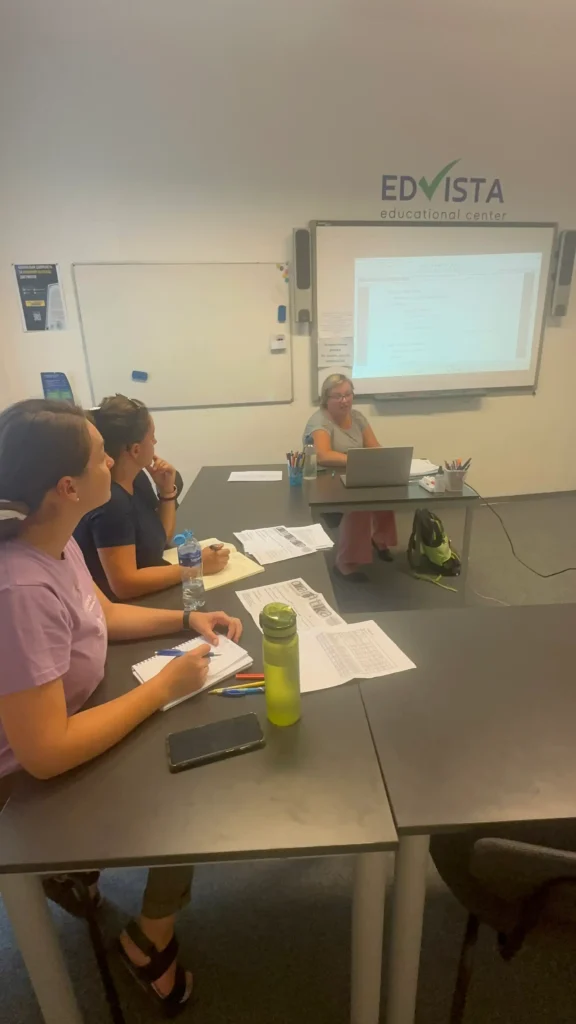
The smartest way to master Czech is to move consistently, step by step, from the simplest to the more complex. At the EdVista educational center in Brno, we created Czech courses for Ukrainians, where you can learn with enjoyment and alongside experienced teachers. Each level is a separate stage that allows you to develop comfortably, without skipping important things.
A1: first steps in the language
Here you will get to know basic words and simple phrases you need every day. After this course you will be able to politely address people, order coffee or lunch, talk about yourself, family, home, plans for the day, and even explain how you feel.
A2: expanding possibilities
At this stage your vocabulary becomes richer and your grammar becomes stronger. You will already be able to write simple letters (both official and friendly), send emails, compose a short story about yourself, and describe what you see around you, culture, events, impressions.
B1: deepening the structure
This is where the real breakthrough happens. At the B1 level, you finally stop simply memorizing individual phrases and begin to see the internal logic of the Czech language.
At this stage, you fully understand the case system. Verb tenses, present, past, future, fit into a clear pattern. It is especially interesting when you begin to feel the difference between perfective and imperfective verbs.
Next come the conditional and imperative moods, passive constructions, and indirect speech. Yes, the list looks impressive, but you know what? When everything is presented sequentially and with a clear system, these elements cease to be intimidating and begin to fit naturally into your speech.
B2: confident proficiency
At this level, there is a qualitative leap. You are no longer just talking, you are formulating complex thoughts and participating in serious discussions at work or in your studies. You can easily understand complex articles, podcasts, and lectures. And you can not only understand, but also defend your position with the necessary arguments. And writing? You create texts of various genres, from business letters to analytics and essays.
How to choose the right class format to learn Czech?
Before you decide on a learning format, try a few options and feel which one fits best.
Group classes
Group classes help you overcome the language barrier faster and get regular practice. Other advantages include:
However, it’s worth considering that the pace of classes is determined by the average level of the group, so sometimes it can be slower or faster than you expect. To reinforce grammar and writing, additional independent work may be needed.
Individual courses
This is a format for those who want maximum personalization and fast progress on difficult topics. The advantages of this format are:
the program is fully tailored to your goals;
the ability to work on specific difficulties;
a flexible pace and focus on weak points;
detailed feedback in every class.
But in this format there is less live interaction with other students, so communication and exchange of experience are limited.
Self-study
Independent practice greatly strengthens any other format and gives a lot of freedom. Main advantages:
a convenient pace, when you can study at any time;
a large choice of resources: textbooks, videos, online platforms;
the ability to focus on your own interests.
However, without a teacher it’s harder to maintain motivation. The lack of constant control and correction of mistakes can slow down progress.
How to learn Czech faster?
We offer a few simple ways to speed up your learning:
It is possible to reach B2 in 8-12 months if you study intensively, or in 12-18 months at a normal pace. Of course, these figures are based on the experience of hundreds of students who have gone through this process.
What really determines success? Three things: regularity, a systematic approach, and competent support from the teacher. That is why structured Czech language courses produce such results, they take you from A1 to B2 gradually, without rush or overload. The teacher notices and corrects mistakes in time, before they become ingrained, and you get enough practice so that the language becomes a natural part of your thinking, rather than a set of memorized rules.
If you need to learn Czech for studying, work, or relocation, go to the EdVista courses page and choose the program that best matches your goals, studying, work, or relocation. Contact us: +420 770 624 146. You can also reach us through messengers that are convenient for you: Telegram and WhatsApp.
Join our social media, Instagram, Facebook, YouTube, and TikTok. We regularly share interesting cases, useful tips, and up-to-date information.