

The cost of studying in the Czech Republic depends on the language and type of university: Czech is free for everyone at state universities, while foreign language studies cost from 3,000 euros per year at state institutions and from 5,000 euros per year at private ones, depending on the specialty. Living expenses add to this: in 2026 they run approximately 800 to 1,500 euros per month. Below we have broken down the full student budget: tuition fees, accommodation, food, transport and insurance, so that you can see the real amount per year.
This article calculates costs at the country level, not the cost of courses at a particular center. We combine official data and practical figures into one budget, which you can use to assess your own situation before you move. We discuss each cost item separately below, with ranges of amounts.
The cost of living in the Czech Republic is lower than in most Western European countries. This is one of the reasons why Ukrainian applicants choose Czech universities: quality education comes with moderate living costs. The main issue is not in the tariffs, but in how to plan the budget in such a way as to avoid hidden overpayments.
Cost of studying in the Czech Republic per year

Tuition fees are the first item on your budget, and they depend the most on your choice. The language of the program and the type of university determine whether you pay tuition at all. Let’s look at three typical situations.
Public universities in Czech for free
In all state universities, Czech-language programs are free for all students, regardless of citizenship. This applies to bachelor’s, master’s, and doctoral studies. Charles University, Masaryk University, Czech Technical University, and other state institutions do not charge fees for studies in Czech.
That is why language proficiency at level B2 directly affects the budget. By mastering Czech, you gain access to free education and save thousands of euros per year. An online intensive Czech language course helps you prepare for this level, which leads from zero to B2 according to a structured program.
Free tuition does not mean no costs at all. Universities may charge small administrative fees for application or document issuance. These amounts are insignificant compared to fees for English-language programs, but they are also worth considering when planning your first year.
How much does it cost to study in English in the Czech Republic?
If you choose a program in English or another foreign language, tuition becomes paid. In public universities, it costs from 3,000 euros per year, and in private ones from 5,000 euros per year, depending on the specialty. Private institutions set their own rates, and they are usually higher.
Medical, technical and business programs in English are more expensive than humanities. For example, studying to become a doctor can cost from 20,000 euros per year. Therefore, before choosing, it is worth considering whether it would be more profitable to learn Czech and enroll in a free program. For many applicants, a year of language preparation pays off in the first year of free study.
Cost of studying in the Czech Republic: nostrification
Before admission, a Ukrainian certificate or diploma must be nostrified, that is, officially recognized in the Czech Republic. The registration fee for submitting a single application is approximately 20-30 euros, and internal nostrification of a Ukrainian certificate at the faculty is another 20-30 euros. Translation of documents into Czech for nostrification costs approximately 100-150 euros.
Nostrification takes 30 to 60 days and sometimes requires additional exams. This affects not only the budget, but also the timing, so it is worth starting the procedure in advance. The admission to Czech universities page describes the procedure in more detail.
Cost of studying in the Czech Republic: accommodation
Housing is the largest item of a student’s monthly expenses. The choice between dormitories and renting has the greatest impact on the final budget. The difference between these options can be several hundred euros per month.
Hostel
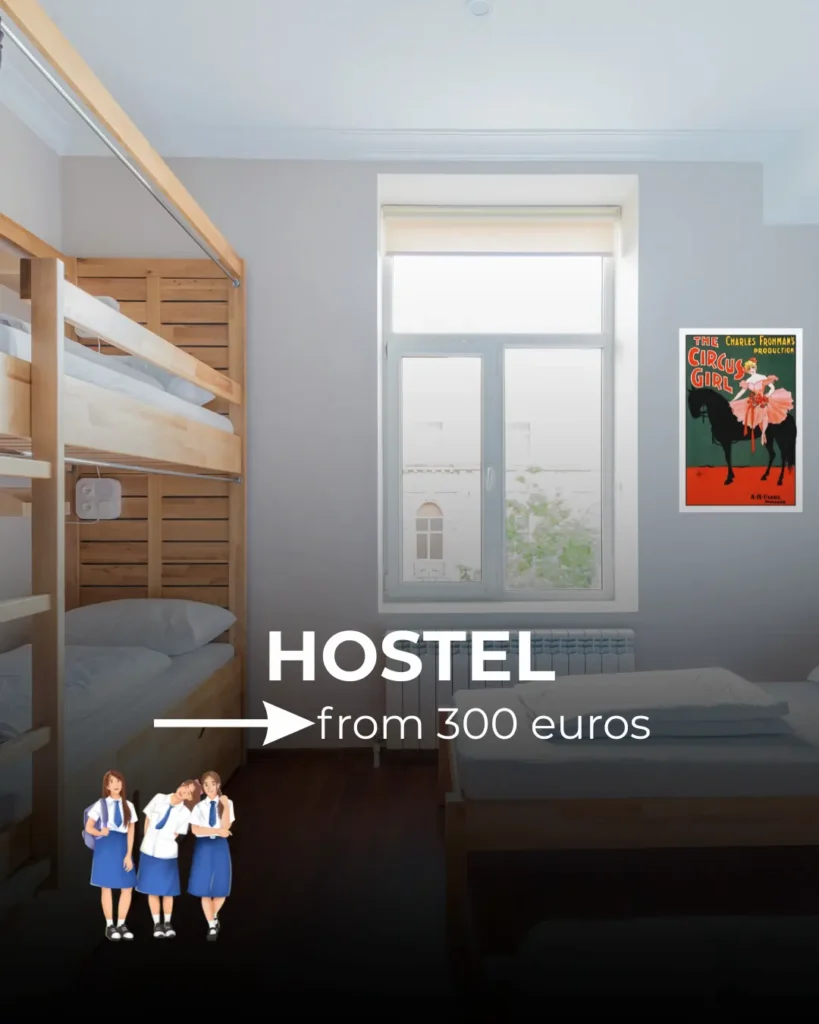
A dormitory is the cheapest accommodation option for a student in the Czech Republic. Public universities offer students dormitory accommodation, although the number of places is limited. In Brno, for example, dormitories start at around 350 euros per month, while in Prague a place costs from 137 to 254 euros (3,500-6,500 CZK).
The rooms are usually double, less often single, with basic furniture and a kitchen on the floor. The price mostly includes utilities, which simplifies budget planning. Students submit dormitory applications in advance through the university, because places are fewer than applicants.
Apartment rental
Renting offers more privacy, but is more expensive. A room in a shared apartment starts at €352 (9,000 CZK), a private room starts at €469 (12,000 CZK), and a studio apartment starts at €781 (20,000 CZK) per month. The rent includes utilities, which the landlord usually does not include in the price.
Sharing a room with other students significantly reduces costs. Instead of paying the full price of an apartment, you share it with several people, and the cost per person is closer to the price of a dormitory. This is a compromise between the privacy of renting and the economy of a dormitory.
When renting, consider the one-time payments at the start. Owners usually ask for a deposit of one or two months’ rent and return it at the end. Sometimes an agency fee is added to this. These amounts are not included in the monthly budget, but you need to have them right away, so it is worth setting them aside as a separate reserve before moving in.
Comparison by city
The city determines the level of housing costs the most. Prague is the most expensive, and rent and dorms are noticeably more expensive there. Brno is a bit cheaper, and smaller university cities like Olomouc or Ostrava offer savings of 78 to 195 euros (2,000-5,000 CZK) per month compared to Prague for similar accommodation.
When choosing a city, you are essentially choosing the level of monthly expenses. Studying in a smaller city is often not inferior in quality, but it significantly reduces the burden on the budget. For students with limited funds, this is a real way to make education more affordable.
It is also worth considering the part-time job market. In Prague, there are more vacancies and higher rates, so some students compensate for the more expensive housing with earnings. In contrast, in smaller cities, housing is cheaper, but there are fewer jobs. This balance between expenses and possible income is also included in the calculation of the real budget for the year.
Cost of studying in the Czech Republic per month
Beyond housing, regular expenses for food, transport and insurance shape the budget. Together, they determine the daily budget of a student. Student expenses in the Czech Republic are predictable in this part, because most of them have fixed student tariffs. Let’s analyze each item separately.

Food
Food costs start at around 200 euros per month, depending on how often you cook at home. Student canteens at universities are a great way to save money: a meal there costs around 3 to 6 euros, compared to 8 euros in a regular café. This is one of the main advantages of being a student.
Buying groceries from Lidl, Kaufland or Albert is cheaper than eating out at a cafe. The combination of eating out and cooking at home keeps food costs at the lower end of the range. For frugal students, this is a manageable budget item.
Lunch in a restaurant costs significantly more than in a student canteen: on average about 8 euros versus 3-6 euros per meal in the refectory. Therefore, regular meals off campus quickly increase monthly food costs, and this is where students most often exceed their planned budget.
Transport
Public transport in the Czech Republic is cheap for students. A ticket for people under 26 costs around 20 euros (500 CZK) per quarter. A single ticket for 60 minutes on any public transport in the city costs around 1 euro (30 CZK). This is one of the smallest items in a student’s budget.
A student card gives you access to discounts not only on transport, but also at cafes, museums and cinemas. The ISIC card extends these benefits to over a hundred countries. Therefore, transport is rarely a problem for your budget if you use student fares.

Insurance
Non-EU students must have health insurance, and visas require it. Comprehensive commercial coverage costs from around €100 per month, depending on the duration and scope of coverage. You should not overlook this expense when planning.
Many students take out a minimum policy and then pay extra to extend coverage. Therefore, it is worth assessing the level of insurance you need right away to avoid overpaying later. It is worth checking the policy requirements with the conditions of your specific visa, as insufficient coverage will result in a refusal to extend your stay.
Communication and everyday life
Mobile communication with a data package costs from 12 to 39 euros (300-1000 CZK) per month. Household expenses are added to hygiene products, clothing and small purchases, which together add up to several thousand CZK. These amounts are small, but they are worth considering.
Leisure expenses depend on your lifestyle. Cinema, concerts and cafes add from several hundred CZK per month. Student discounts significantly reduce these amounts, so active leisure does not necessarily destroy the budget.

Traveling in Europe
A separate article for many students is traveling around Europe. The Czech Republic’s location in the center of the continent provides cheap access to neighboring countries by train and low-cost airlines. An approximate budget for travel starts at 400 euros, depending on the destinations and frequency, and this amount should be set aside separately from monthly living expenses.
Cost of studying in the Czech Republic: final budget
Calculating your yearly budget
To estimate your full budget for the year, add up your tuition fees and twelve months of living expenses. For studying Czech at a state university, the fees are zero, so living expenses make up the entire budget. At 800-1500 euros per month, a year comes out to around 9600 to 18,000 euros.
If you choose an English-language program, this amount is added to the tuition fee of 3,000 euros per year at a public university or 5,000 euros at a private one. Together with accommodation, the total increases accordingly. Therefore, the language of instruction is the main lever that determines the total cost of the year.
Students from outside the EU must prove that they have sufficient funds to cover their living expenses for a long-term visa. The amount is approximately 115,810 CZK per academic year and is calculated from the essential minimum of 3,130 CZK per month. This figure is reviewed periodically, so it is worth checking the current rate before applying. You need to show funds before you get a visa, so it is worth planning ahead.
How to reduce the cost of studying in the Czech Republic
Real savings come from preparing for admission and knowing the language. Mastering Czech opens up access to free education, and a smart choice of city reduces living costs. Preparing for university admission, which combines language and entrance exams, helps you prepare systematically.

Choosing the right university and major also affects your budget and timeline. This choice is explained step by step on the page How to Choose a University and Major in the Czech Republic, and a general plan for preparing for admission is described in the article How to Prepare for Admission to the Czech Republic in 2026. Together, these steps give you control over the amount you spend on your studies and living expenses.
By calculating all the budget items together, you will understand how much studying in the Czech Republic costs in your case. You can check official data on living expenses on the Czech Republic admission portal, and financial requirements for a visa are described on the official portal of the Czech Ministry of Foreign Affairs. This will allow you to plan your studies and relocation consciously, based on specific figures, rather than approximate estimates.