Home » One day at an intensive Czech language course: what it looks like
One day at an intensive Czech language course: what it looks like
26.06.2026selector.space
Intensive Czech language courses allow you to master the language in a few months instead of several years. The online format makes it accessible regardless of where you live: EdVista students from Ukraine, the Czech Republic, Germany and other countries study in real time with a live teacher. To understand how intensive Czech language courses are organized online, it is worth considering one typical school day from the inside.
How does a day at an online intensive begin?
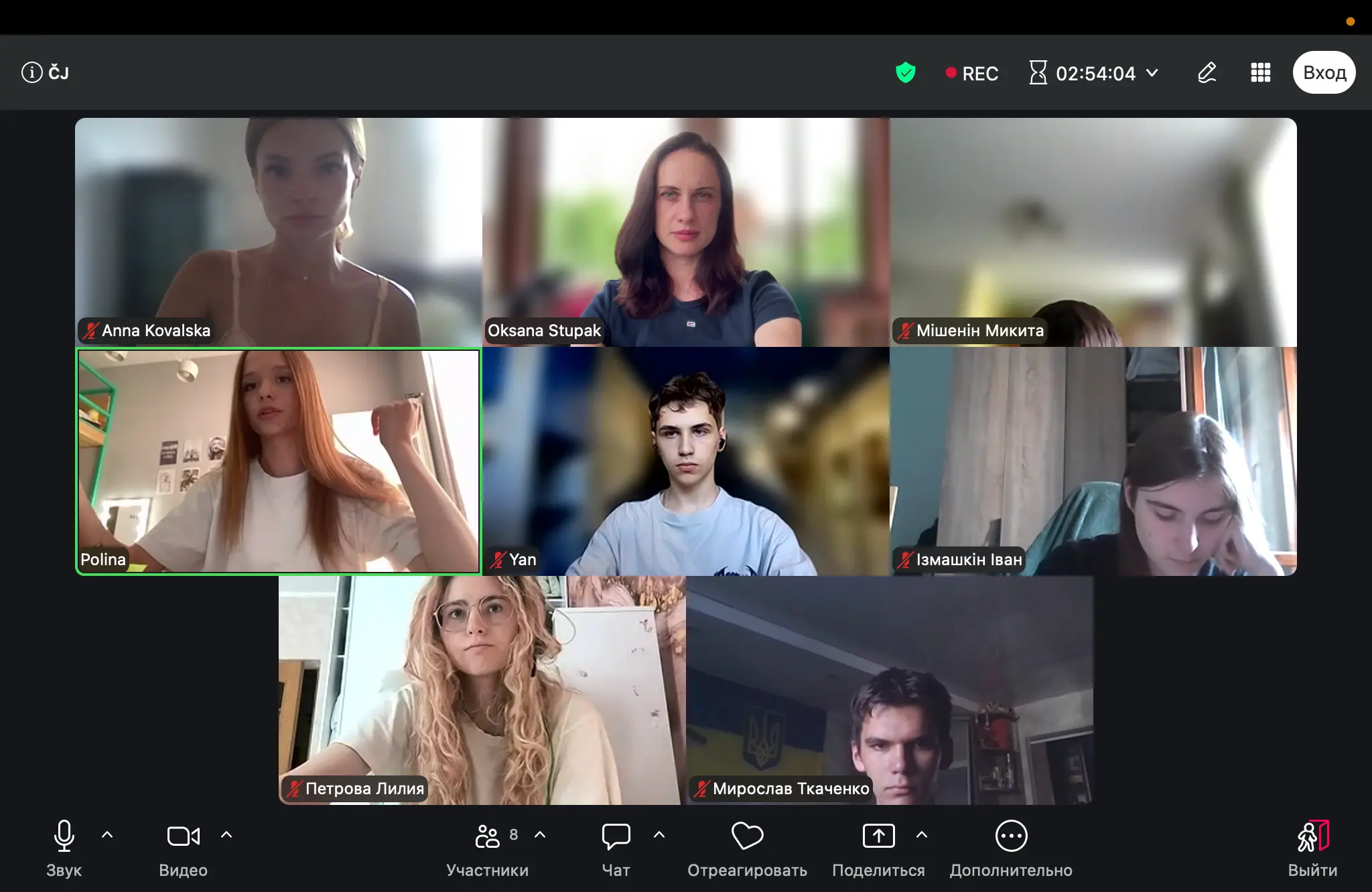
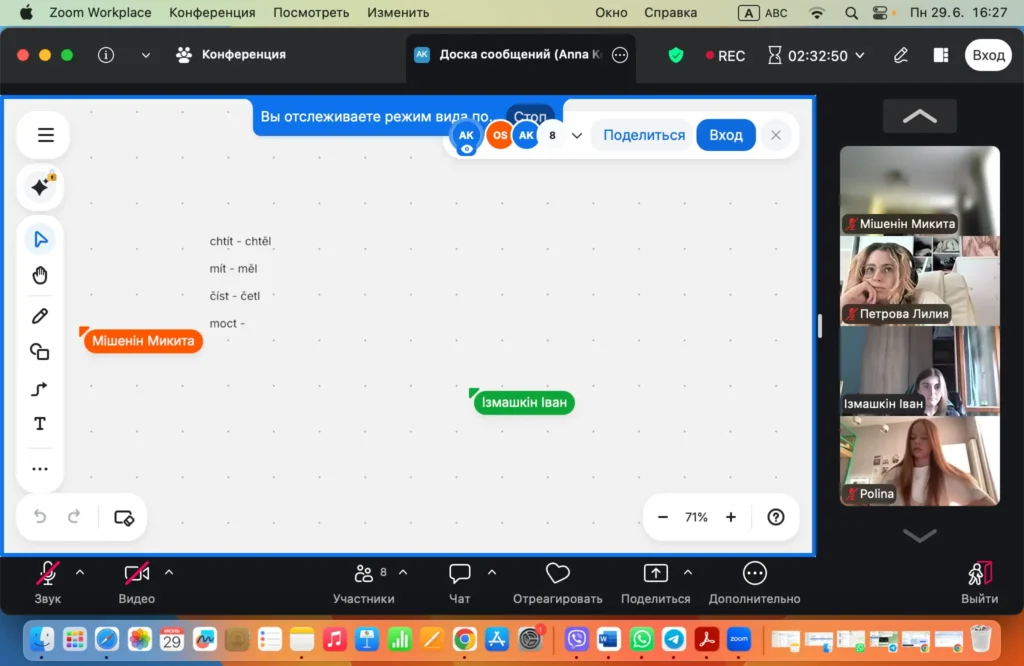
The day at the intensive Czech language courses starts at 8:00 or 9:00 am, depending on the group. The student receives a message with a link to the class on Zoom or Google Meet 10 minutes before the start. No additional preparation is required: the teacher sends all the materials to the shared chat the evening before. On the screen, the student sees a video of the teacher and the rest of the group, a shared document with the lesson materials, and a chat for short answers. A camera is required during the class. The microphone is turned on as needed: during the explanation, most students listen, during speaking practice, everyone speaks in turn.
The first 5-10 minutes of the lesson are devoted to reviewing what has been learned. The teacher asks short questions orally or via chat, and students answer. This is not a test, but a warm-up: the brain switches to Czech and remembers yesterday’s material. Online Czech courses at EdVista are built on the principle of daily repetition, as it is this that ensures long-term mastery of vocabulary and grammar. The size of groups in intensive Czech courses is small: usually from 5 to 8 students, which allows the teacher to pay attention to everyone.
Lesson structure in intensive Czech language courses
In intensive Czech language courses, one lesson lasts 90 minutes and is divided into three consecutive blocks. The first block is dedicated to the introduction of new material: a grammatical construction or a lexical topic. The teacher explains, gives examples, students listen and immediately ask questions in the chat or by voice.
The second block is dedicated to practice. Students complete exercises in real time: fill in the blanks, translate sentences, answer questions. The teacher sees the answers immediately and corrects mistakes without unnecessary delay.
The third block is devoted to conversational practice. Students receive a topic and communicate with each other or with the teacher in Czech: order coffee, describe the route, talk about weekend plans. This is the most important block for those who learn Czech online for the purpose of real use, and not just passing exams. The teacher assigns different pairs for conversational practice each time so that students do not get used to the same interlocutor. The lesson is recorded: the student can watch the recording after the lesson and hear his speech from the outside. This is one way to notice pronunciation errors that are difficult to track during a conversation on your own.
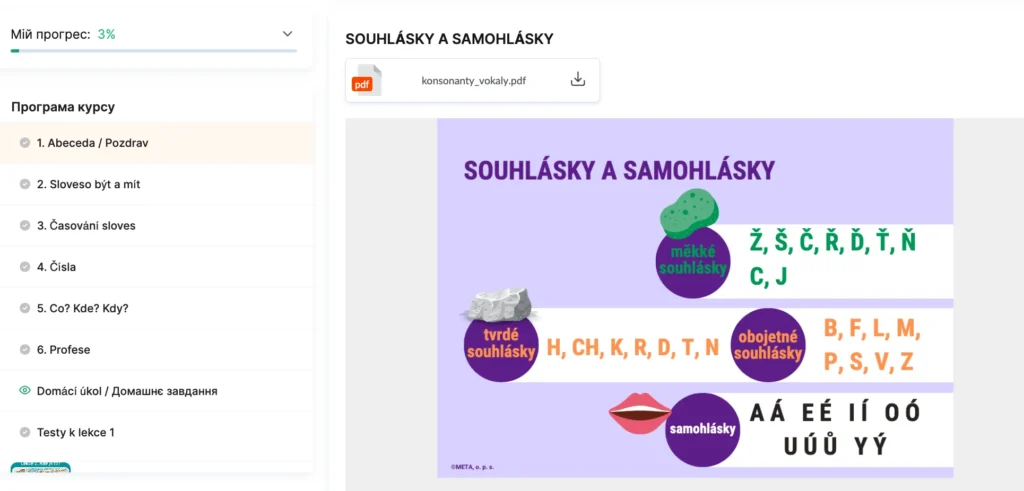
On the Kwiga platform, students can also watch videos from the teacher explaining the main important topics of Czech grammar and vocabulary. And completing quizzes and interactive tasks helps to practice the studied material.
The lesson ends with a brief summary: what was learned today and what needs to be reviewed by tomorrow. The teacher announces the homework orally and duplicates it in the chat.
It is worth mentioning separately the language of communication during classes. From level A1, classes are conducted in Czech so that students are immersed in the language environment, hearing the correct accents and pronunciation from the first lesson. This natural immersion in the language is one of the key advantages of intensive Czech language courses.
What happens between intensive Czech lessons: assignments, feedback, practice
After classes in intensive Czech language courses, students receive 20-30 minutes of homework. Usually, this is a short reading text, several grammar exercises, and one writing task: write 5-7 sentences on a given topic in Czech.
Students send completed tasks to the platform for checking by the teacher. Some tasks are in the format of quizzes: the student immediately sees the correct answer and can go through the topic several times to work it out to a confident result.
Between classes, students also have access to additional materials: audio recordings of dialogues, word lists, short videos. All this is collected on the Kwiga platform, which is accessible throughout the course. That is why intensive Czech language courses give results in 5 months: the density of contact with the material during the day is significantly higher than in classes once a week.
In addition to live classes, each student gets access to a personal chat with the teacher for urgent questions. If something is unclear after the lesson or a question arises while doing homework, the answer usually comes within a few hours. This is especially important in intensive Czech language courses, where the material accumulates quickly and an open question can slow down the assimilation of the next one.
A brief overview of the Kwiga platform from a teacher
Research in the field of foreign language learning confirms that intensive learning with a high frequency of classes produces significantly better results compared to one or two lessons per week. Learn more about the effectiveness of intensive language learning: https://www.sciencedirect.com/science/article/pii/S0346251X23001398.
What does progress look like during a week of intensive training?
During the first week, the student takes 6 to 8 90-minute lessons. This is 9 to 12 hours of pure study time plus homework. This pace explains why intensive Czech language courses produce results much faster than the standard twice-weekly format.
By the end of the first week of intensive Czech language courses, a student who started from scratch usually knows how to: greet and say goodbye, state their identity and age, ask for the price and order something in a cafe, and understand simple short texts in Czech. Students at level A2 begin to construct sentences more confidently by the end of the week and notice that they understand more of what they hear in real language.
Progress is recorded in writing: at the end of each week, the student receives a short report from the teacher with an assessment of achievements and specific recommendations for the next week. Thanks to this, the student always understands where there is improvement and where more attention is needed. After the first month of study, the teacher assesses the student’s level and, if necessary, recommends moving to the next group or additional study of specific topics.
It is important to understand that the pace of learning in intensive Czech language courses requires regularity. Missing even one lesson is noticeable in the next lesson, since each lesson builds on the previous one. That is why EdVista students are encouraged to plan their schedule in advance and report possible absences: the teacher may offer a recording of the lesson or materials for independent study.
EdVista’s learning formats are designed for different levels of preparation. Intensive Czech language courses here cover the path from complete zero to level B2, sufficient for university admission. For those who want to start from scratch or brush up on their skills, an online intensive Czech language course is suitable. If the level is already A2-B1 and the goal is to reach B2, there is a special intensive B1-B2 course for five months. For those looking for a complete path from zero to B2, a program from 0 to B2 has been developed. You can view all available formats on the online Czech language courses page.