Home » Free Education in the Czech Republic for International Students
Free Education in the Czech Republic for International Students
16.10.2026selector.space
Free education in the Czech Republic for international students is available in Czech-taught programs at public universities. On 15 October 2026, EdVista hosted a webinar for applicants called “Studying at a Czech university: step-by-step admission plan and students’ experience”. EdVista founder Oksana Stupak led it. She is a Doctor of Pedagogical Sciences and a lecturer at Masaryk University. Two current students shared their own path: Dmytro, a first-year student, and Liza, a master’s student.
Below we summarize the main points: the rules of free study, the admission route, student life and common mistakes.
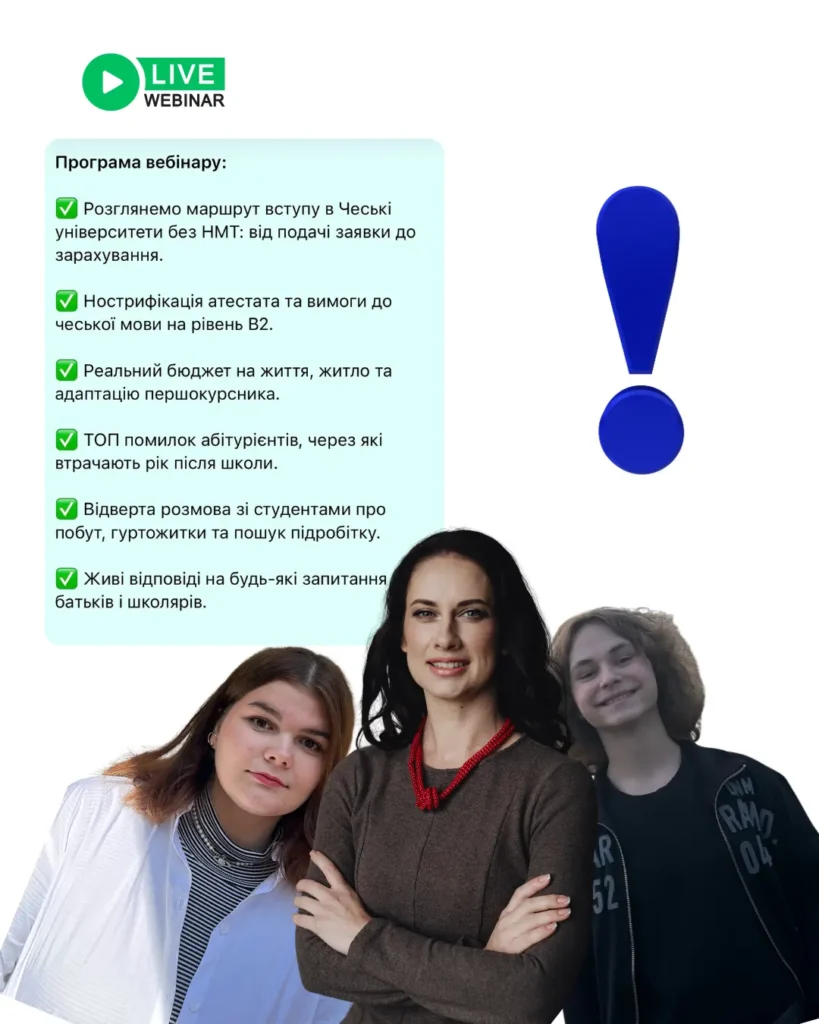
Original webinar announcement sent to subscribers in Telegram
Free education in the Czech Republic for international students: the main rules
Is Czech Republic tuition free for international students? Yes, if you study in Czech at a public university. Public universities apply the same conditions to all applicants regardless of citizenship. The EU portal Study in Czechia confirms that Czech-taught programs at public institutions are free for students of all nationalities.
Programs taught in English usually charge tuition, and private universities set their own fees. Fees vary by university and program. We compare the options in our article on English programs at Czech universities.
The main condition for Czech-taught programs is the language. Most programs require Czech at B2, so to study in the Czech Republic for free you need the language first. According to Oksana Stupak, some universities accept B1, but this is an exception rather than the rule.
Free higher education in the Czech Republic covers bachelor’s, master’s and doctoral programs taught in Czech. A bachelor’s program usually takes three years and a master’s program two years. Czech Republic free education also has a time limit. Students who exceed the standard length by more than one year pay a fee for the extra time. The rule comes from the Higher Education Act.
There are three ways to get into a Czech-taught program, and Oksana Stupak described each of them at the webinar:
An entrance exam plus a Czech language certificate.
An entrance exam only, when the university treats a passed exam as proof of language.
Admission without exams, based on school grades and a B2 certificate.
For the third option, universities convert your grades into the Czech five-point scale, where 1 is the highest mark. The list of programs that admit without exams usually appears in late November or early December. Combining options with and without exams gives you a backup plan.
Choose universities and programs, ideally in September, October or November.
Submit applications, usually from November to the end of February, March or April.
Take entrance exams, mostly in April and May.
Have your school diploma recognized through nostrification.
Enroll at the chosen university.
Applications for creative programs open earlier, in September and October. If you are not admitted, some universities open a second round in July or August.
Nostrification has two forms. Internal nostrification is done by the faculty and recognizes your diploma only for that faculty. External nostrification is valid in the whole country but takes more time and may include extra exams in Czech. For external nostrification, the diploma needs an apostille or superlegalization. Read more about apostille for the Czech Republic and nostrification in the Czech Republic.
Students’ experience: housing, part-time work and adaptation
Many applicants look for real stories about free university education in the Czech Republic before they decide. Here is what the two guests of the webinar told the audience.
Dmytro, first year at Mendel University in Brno
Dmytro studies regional development at Mendel University in Brno. He entered at 17, right after school. For nine months he studied Czech with an EdVista group. At the same time, he prepared for the TSP entrance test. Dmytro passed the B2 exam on his first attempt.
He called the fear of not understanding lectures in Czech a myth. In his words, “If you learn the language properly and take it seriously, everything is clear.”
Lectures gather about 200 students and attendance is optional. Seminars matter more, because students earn extra points there.
The hardest part at the start was finding friends. Dmytro spent his first week alone, then met other Ukrainians and later Czech classmates. Most of them are around 20, so the age gap felt strange at first. His advice for learning Czech is to switch everything around you to the language: books, series, news and even your phone. “Just patience and strength,” he summed up.
Liza, master’s student at Charles University
Liza came to Czechia at 19 after a teacher training college, without any Czech. She learned the language in daily life, at free courses and with a private tutor. Within three months she spoke freely and found part-time work in a shopping center.
She completed a bachelor’s degree in Czech language at the University of Ostrava. Now she studies for a master’s degree at the Faculty of Arts of Charles University. Students build their own schedules, so Liza keeps one day a week free for work. She warned about credits: if you do not collect enough credits, your studies end.
Liza lives in a dormitory in Prague and notes that Prague is more expensive than Ostrava. The ISIC student card gives discounts on transport, food and books. Living costs depend on the city and the type of housing. Our article on the cost of studying in the Czech Republic explains them in detail.
Full-time students in accredited university programs have free access to the Czech labour market. The Ministry of the Interior describes the rules for part-time work on its portal for foreigners.
Where can I find free Czech courses? Liza started with free courses for people with temporary protection, which ran in 2022. She noted that such courses vary in quality, so she added lessons with a tutor. For systematic preparation up to B2, consider our Czech courses, which lead from zero to B2.
Free education in the Czech Republic for international students: mistakes that cost a year
At the end of the webinar, Oksana Stupak named the mistakes she sees most often in applicants’ families.
The first one is starting the language too late. Some parents come in May and hope to learn Czech in a few weeks. “You cannot learn Czech in a hurry,” she explained.
The second concerns documents. A translation made abroad may not be accepted, and the university can ask for a translation made in Czechia. Some faculties also request extra certificates, for example about the accreditation of your school. Without a complete set of documents, the application is rejected even after successful exams.
The third mistake is missing deadlines. “If the application deadline is 28 February, you cannot apply on 1 March,” she said. Universities communicate by email, so check your inbox regularly.
The fourth is leaving housing to the last moment. First-year students do not always get a place in a dormitory. For example, the Faculty of Medicine at Masaryk University houses senior students first. We collect more examples in the article on spring applicants’ mistakes.