Home » Top mistakes of applicants in the spring: language, documents, choice of specialty, deadlines
Top mistakes of applicants in the spring: language, documents, choice of specialty, deadlines
25.03.2026selector.space
Spring applicants’ mistakes become critical because there is less time to correct them. Applicants need to handle language, documents, the choice of specialty and deadlines in parallel. Most often, 4 mistakes ruin preparation. These mistakes include an incorrect assessment of the Czech language level and a late start with documents. They also include choosing a specialty without analyzing the requirements and underestimating deadlines. The problem lies not only in the language. It also lies in the coordination of the entire admission route. Each stage affects the next.
Spring applicants’ mistakes: why they become critical
In the spring, spring applicants’ mistakes become more dangerous. There is less time left before the entrance stages. There is almost no room left to correct incorrect decisions. At an early stage, extra time can still compensate for a mistake. In spring, any delay quickly turns into a real problem.
Deadlines become closer during this period. Because of this, applicants have to make decisions faster and more accurately. Applicants can no longer postpone choosing a university, checking requirements, preparing documents and language study. All these processes start pressing at the same time.
Another reason is simple: language, documents and route planning have to move in parallel in spring. It is not enough to only start learning Czech or focus only on admission papers. If one part drops out, the whole preparation loses structure and the route becomes chaotic.
That is why any mistake in the spring affects the result more quickly. An incorrectly assessed language level can derail the plan. A late start with documents can do the same. Untimely verification of program requirements also reduces the chances of a smooth admissions process.
Mistake 1 – incorrectly assessing their level of Czech
Focus on feelings, not real diagnostics
One of the most common mistakes is to assess your level of Czech based on your own feelings. Some applicants feel that they already “understand something” or can maintain a simple conversation. This still does not mean their level meets admission requirements. Without diagnostics, applicants often overestimate their abilities or choose the wrong training format from the start.
A correct assessment of the level of the Czech language helps to choose a realistic route for preparing for admission.
Domestic communication does not mean readiness for entry
Another common mistake is confusing everyday language comprehension with real readiness for university studies. The ability to solve simple everyday problems, understand basic phrases, or maintain a short conversation is not the same as academic readiness. Academic readiness means listening to lectures, reading academic texts, working with terms, and completing written assignments. That is why everyday comfort with the language is not evidence of readiness for the entrance process and academic workload.
They choose a route not for their level, but for the desired result
Applicants often ignore their real starting point. Instead, they focus on the result they want to get as quickly as possible. Because of this, a person with basic knowledge may choose a route that is too difficult. Someone with a stronger base may waste time on a format that does not match their level. As a result, preparation becomes less effective and the admission route becomes harder to manage.
Mistake 2 – putting off documents for later
They start collecting documents too late.
One of the typical mistakes is postponing document preparation until the language level seems “advanced enough”. Because of this, the applicant loses time and has to complete important stages in a hurry. The package of documents should not be left for the final stage, because its preparation also requires time, attention and checking of details.
They don’t check the submission requirements in advance
Another problem is to focus on general ideas about admission, rather than specific application requirements. If the applicant does not check in advance what documents are required, when they should be submitted, and what conditions apply to a particular program on the Study in Czechia portal, the preparation quickly becomes chaotic. In such a situation, even a minor inaccuracy can lead to a delay in the entire route.
They do not take into account that the speech and documents should be prepared in parallel
Applicants often treat language preparation and documents as two separate stages. In spring, this logic no longer works. If you wait until the language is “ready” and only then move on to the papers, you may run out of time. That is why the language, documents, checking the requirements and choosing a program should move in parallel, and not one after the other.
Mistake 3 – choosing a specialty or university without analyzing the requirements
Focus on the name or someone else’s advice
One of the most common mistakes is to choose a major or university based on a general impression, a popular name, or advice from friends. This approach seems simple, but it does not take into account whether this option really meets your situation, language level, and real entrance requirements. As a result, the applicant begins to move in a direction that may turn out to be unsuccessful at the next stage of preparation.
They do not check the language and entrance requirements of the program
Another mistake is not checking separately what language and entrance requirements a particular program has. Even if the general idea of the specialty is suitable, this does not mean that the admission route will be the same for all options. If an applicant does not check the requirements in advance, he risks choosing a direction for which he is not ready either in terms of language or the structure of the entrance stages.
They do not link the choice of specialty to their own training route
You cannot separate the choice of a major from language preparation, deadlines and the overall admission plan. If an applicant chooses a program without considering their starting level, preparation time and route complexity, even a good option on paper can become too difficult in practice. That is why the major and university should be chosen not in isolation, but in conjunction with their own training route.
Mistake 4 – Underestimating deadlines and real workload
They think there’s still enough time
One of the most dangerous mistakes in the spring is the belief that there is still plenty of time to prepare. Because of this, the applicant postpones important decisions, does not decide on a specialty, does not check the requirements and does not start preparation in full. In practice, it is in the spring that the time reserve is already sharply reduced, so any delay quickly affects the entire admission route.
Do not correlate the deadlines with the pace of language learning
Another common mistake is to look at deadlines separately from the actual pace of language training. If an applicant wants to reach a higher level of Czech, but does not correlate this with the amount of time left, the plan becomes disconnected from reality. In such a situation, even the correct goal may turn out to be unattainable simply because the pace of learning does not match the deadlines.
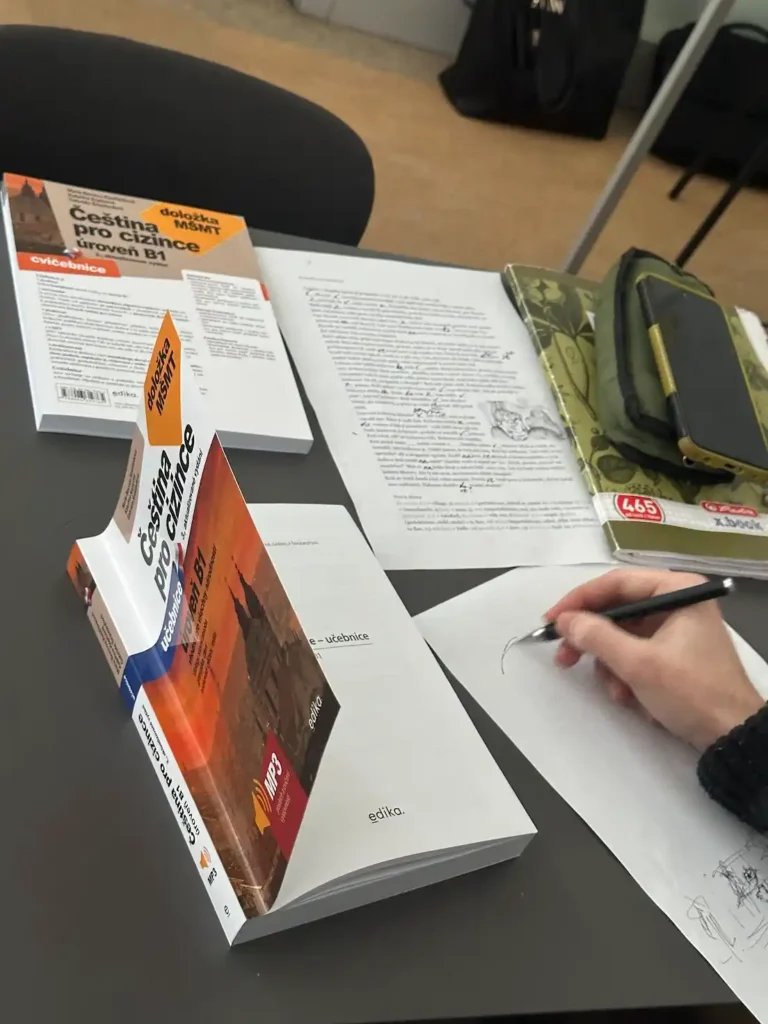
Preparing for admission to the Czech Republic requires a realistic pace of study and work with materials.
They don’t plan training in stages.
When applicants do not break preparation into stages, the whole process turns into a set of separate actions. An applicant may think about language, documents, university and entrance requirements at the same time, but without a clear order these tasks do not form a manageable route. That is why in the spring it is especially important to plan preparation in stages so that each step works for the result, and does not create additional chaos.
Spring applicants’ mistakes: how to build the right preparation route
The correct route without spring applicants’ mistakes does not begin with a chaotic choice of a course or university, but with a consistent assessment of the situation. The first step is to determine the real level of the Czech language in order to understand the starting point and not build preparation on assumptions. Without this, it is difficult to choose both the pace of study and a realistic route to admission.
The right preparation route helps to combine language, documents and introductory stages
After this, it is worth moving on to choosing a specialty and university. It is at this stage that the applicant should correlate his goals, language level, time for preparation and possible format of study. If the direction is chosen correctly, then you can check the specific requirements of the program and understand what language level, what documents and what admission stages will be required.
The next step is to check the requirements and prepare documents in parallel. It is important not to postpone this stage until the language preparation is almost complete. Documents, submission deadlines, program conditions and admission route should move simultaneously, and not one after the other. It is this logic that allows you to avoid a situation where one mistake shifts the entire plan.
The final stage is choosing the training format that best suits your situation. If you need:
a flexible schedule and systematic learning, a course is suitable;
to move to a new language level faster, you should consider an intensive course;
to learn the language, prepare documents, and keep the entire admission route under control, it is advisable to choose a course with support. It is this sequence that makes training not chaotic, but manageable. Czech courses from 0 to B2.
Spring applicants’ mistakes: when support really reduces the risk
Support really reduces the risk of error when applicants’ mistakes in the spring can quickly affect the entire admission route. In such a situation, it is important not just to learn the language, but to immediately move along the route, where each stage is connected to the next. That is why support is most helpful when preparation begins later and any inaccuracy quickly affects the result.
Support is also appropriate when there is no clear plan. If an applicant does not understand where to start, what order to follow and what to focus on first, preparation quickly becomes chaotic. In this case, support helps build the route in stages and shows what decisions to make at each step.
Separately, support reduces the risk of error when it is difficult to independently understand the requirements of the program, university or admission route. If an applicant is not sure what documents are needed, what language level is realistic and how to combine all the stages of preparation, without systematic support it is easy to waste time on the wrong actions. In this case, support helps to connect the requirements of the program with the real situation of the applicant.
Support is also especially relevant when it is necessary to combine language preparation, documents and deadlines at the same time. If these processes are carried out without coordination, any one failure begins to drag others along. That is why support reduces the risk of error not only at the level of a separate stage, but at the level of the entire admission route.
What EdVista offers for those who don’t want to go this path chaotically
EdVista offers several training formats for those who want to avoid spring applicants’ mistakes and choose a realistic preparation route. If the applicant wants to systematically study the language, you can choose Czech courses from 0 to B2. If the main goal is admission, EdVista also offers separate preparation for Czech universities. In this format, the language route is combined with program requirements, the choice of institution and the overall preparation logic.
A separate format is admission support for those who care not only about learning the language, but also about keeping the entire process under control. In this case, preparation is not limited to classes, but is combined with choosing a specialty, checking requirements, preparing documents and coordinating the admission stages.
EdVista also works with different routes depending on the starting level. If the preparation starts from scratch, you can build a 0-B2 route. If you already have a base, A2-B2 or B1-B2 become realistic options. It is this system that helps you choose not an abstract course, but a format that corresponds to the real goal of admission and the starting point of the applicant.
Frequently asked questions
Is it too late to start preparing for spring admission?
No, but spring applicants’ mistakes have a faster impact, so preparation already requires a clearer route and faster decisions. The less time remains, the more important it is to immediately correctly assess the language level, program requirements, and application deadlines.
What comes first: language or documents?
Do not divide language and documents into two consecutive stages. If preparation begins in spring, handle them in parallel so that one part does not delay the other.
When does a mistake in choosing a specialty become critical?
The mistake becomes critical when the applicant has already invested time in a route that does not meet the requirements of the program or their actual level of preparation. In such a situation, it is necessary to restructure both the language plan, documents, and deadlines.
In what cases is it worth hiring an escort?
Support is worth considering when preparation starts in the spring, there is no clear plan, or it is difficult to combine language, documents, and deadlines on your own. In such cases, it helps reduce the risk of mistakes along the entire admission route.